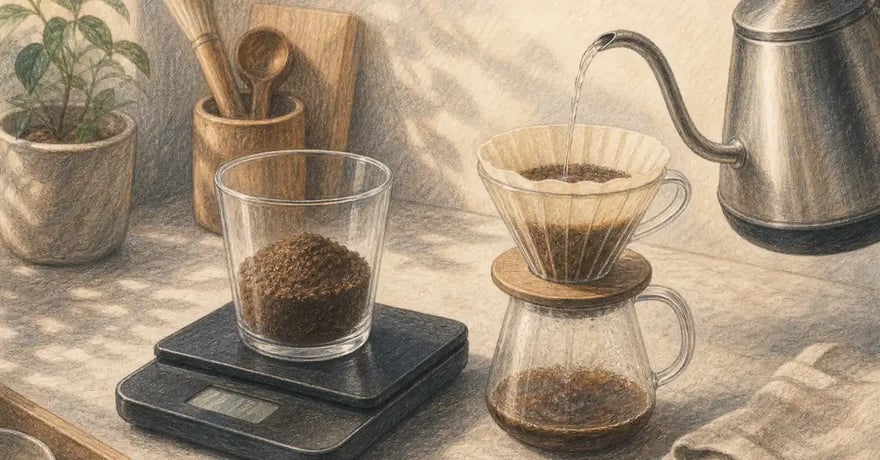
The short answer: for most filter coffee, use a ratio of about 1:16 to 1:17 — roughly 1 gram of coffee for every 16–17 grams (milliliters) of water, or about 60 g of coffee per liter. That is the "golden ratio" the Specialty Coffee Association range is built around. But every brew method has its own sweet spot, from a tight 1:2 for espresso to a loose 1:8 for cold-brew concentrate. Use the table below, weigh your coffee and water with a scale, and adjust to taste.
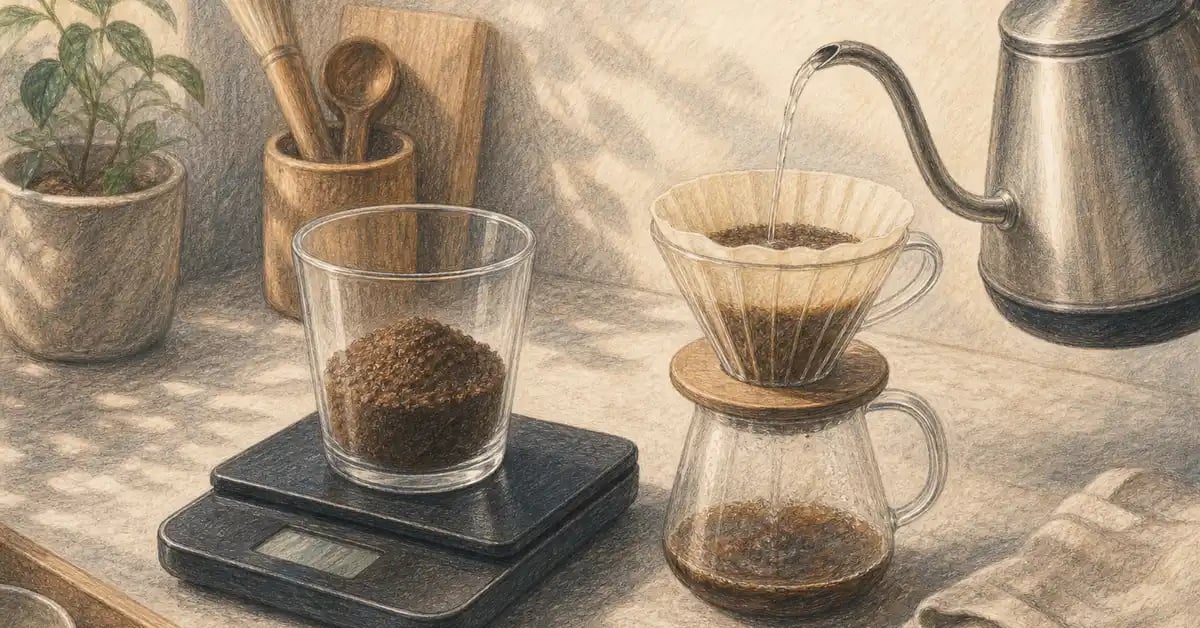
Coffee-to-water ratio by brew method
| Method | Ratio (coffee:water) | Example | Notes |
|---|---|---|---|
| Espresso | 1:2 | 18 g in → ~36 g out | A tight ratio for a concentrated shot; weigh the shot, not just the dose. |
| Moka pot | ~1:7–1:10 | Fill basket level; fill boiler to the valve | Strong, espresso-adjacent; the pot largely sets the ratio. |
| Pour-over (V60, Kalita, Chemex) | 1:16–1:17 | 20 g coffee → ~320–340 g water | The classic clean, bright filter ratio; adjust grind to hit your time. |
| Drip machine | 1:16–1:17 | ~60 g coffee per liter | Same golden range; use the carafe markings and a scale for the dose. |
| French press | 1:12–1:15 | 30 g coffee → ~400–450 g water | A touch stronger and heavier-bodied; coarse grind, 4-minute steep. |
| AeroPress | 1:12–1:16 | ~15–17 g coffee per cup | Very flexible — go stronger and dilute, or brew closer to filter strength. |
| Cold brew (concentrate) | 1:4–1:8 | 250 g coffee → 1–2 L water | Makes a concentrate to dilute; steep 12–24 h, then cut with water or milk. |
A lower number (like 1:12) means more coffee and a stronger, heavier cup; a higher number (1:17) means a lighter, cleaner cup. Start in the middle of a method's range and move one gram at a time.
How to measure your ratio
Weigh, don't scoop. A digital scale (0.1 g resolution is ideal) is the single biggest upgrade to consistency, because scoops of whole beans vary wildly by roast and bean size. Weigh your coffee dose in grams, then weigh the water (1 ml of water = 1 g), and you have your ratio. Grind fresh with a burr grinder just before brewing — grind size controls extraction speed, and the two work together. For the gear, see our best coffee grinders and the Home Coffee Gear guide.
Dial it in by method
Once you know the ratio, the method-specific technique does the rest. Follow our step-by-step guides: pour-over, French press, moka pot, AeroPress and cold brew. Shopping for the brewer itself? Compare options in our Brewing Methods hub — including the best pour-over makers, French presses and cold brew makers.
Frequently Asked Questions
What is the golden ratio for coffee?
The commonly cited golden ratio is about 1:16 to 1:18 — one gram of coffee to 16–18 grams of water, or roughly 55–60 g of coffee per liter. It's the sweet spot for balanced filter coffee, and a sensible starting point you then adjust to taste.
How much coffee per cup of water?
For a single ~240 ml (8 oz) cup of filter coffee at a 1:16 ratio, use about 15 g of coffee. For a stronger French-press cup, closer to 1:13 (about 18 g) works well. Weigh both the coffee and the water for repeatable results.
Is a 1:15 or 1:17 ratio better?
Neither is universally better — 1:15 gives a stronger, fuller cup and 1:17 a lighter, cleaner one. Start at 1:16 and move by one gram of water at a time until it tastes right for your beans and palate.
What ratio should I use for espresso?
Modern espresso uses a brew ratio around 1:2 — for example 18 g of coffee in the basket yielding about 36 g of liquid espresso in the cup. Ristretto shots go tighter (around 1:1.5) and lungo shots looser (1:3+).
What's the best ratio for cold brew?
Cold brew is usually made as a concentrate at roughly 1:4 to 1:8 coffee to water, steeped 12–24 hours, then diluted to taste with water, milk or ice. A 1:4 concentrate is strong enough to cut roughly half-and-half.
Café Grade is research-led: these ratios reflect widely-published specialty-coffee guidance and brewer documentation. Ratios are starting points — taste and adjust for your beans and equipment. Written by Michael Probert.