Disclosure: Café Grade is reader-supported. Some links on this page may become affiliate links — if you buy through them, we may earn a commission at no extra cost to you. We are not yet enrolled in the Amazon Associates program; every Amazon link here is untagged.
Price tiers are relative to this guide: $ = budget · $$ = mid · $$$ = premium · $$$$ = high-end.
To use a French press, add coarsely ground coffee at a 1:15 coffee-to-water ratio (e.g. 30 g coffee to 450 ml water), pour water heated to 195–205°F, stir briefly, place the lid on, and steep for 4 minutes. Press the plunger slowly, then pour immediately. That's the whole method — everything else is dialing it in to your taste.
Quick-Reference Recipe
- Ratio: 1:15 (e.g. 30 g coffee : 450 ml water)
- Grind: Coarse — like coarse sea salt
- Water temp: 195–205°F (just off the boil)
- Steep time: 4 minutes
- Action: Press slowly, pour immediately
French press is one of the most rewarding brewing methods for home baristas. The immersion process — where grounds stay fully submerged for the entire brew — produces a full-bodied, oils-forward cup that automatic drip machines simply can't replicate. But the forgiving reputation can lead people to overlook the few variables that really matter. Get the grind, temperature, and timing right, and you'll brew a genuinely café-grade cup every morning.
What You'll Need
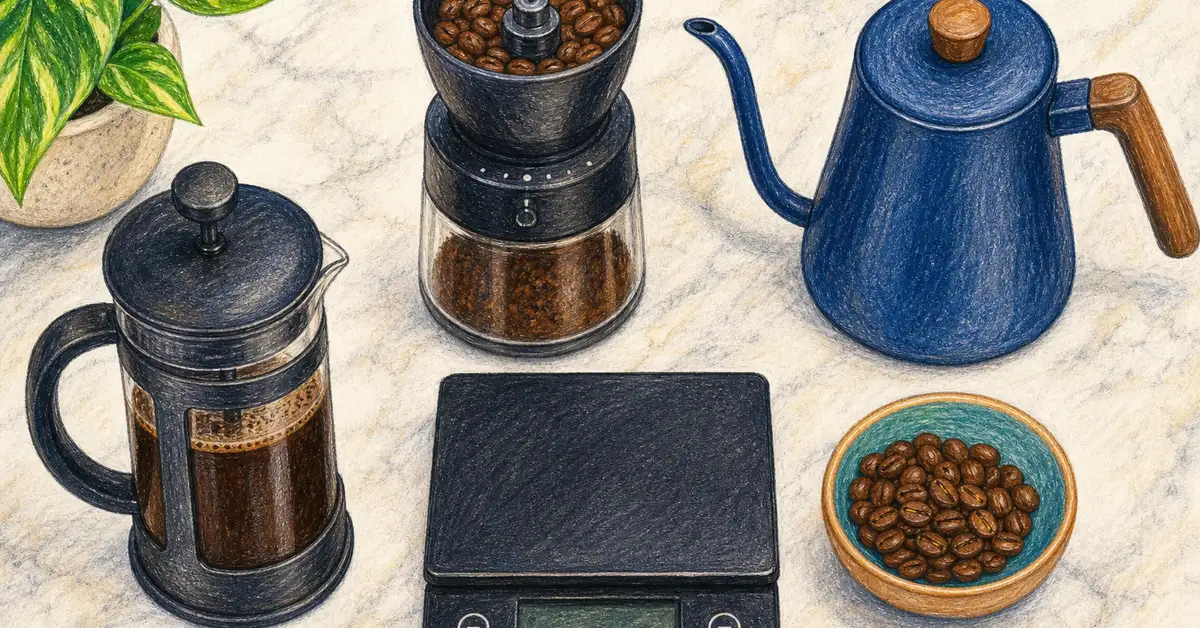
You don't need much. Here's the short list:
Equipment
- French press (any size)
- Burr grinder (strongly recommended)
- Kettle — gooseneck ideal, any works
- Kitchen scale
- Timer
- Spoon or stirrer
Ingredients
- Whole-bean coffee (medium-dark or dark roast works best)
- Filtered water
A scale is optional but highly recommended for consistent results.
If you don't already have a good grinder, a burr grinder will make more difference than anything else you can buy. Blade grinders produce uneven particle sizes that lead to inconsistent extraction — some grounds over-extract (bitter) while others under-extract (sour) in the same brew. See our guide to the best coffee grinders for recommendations across every budget.
Step-by-Step: How to Brew French Press Coffee
Heat Your Water
Bring water to a boil, then let it sit for 30–45 seconds. Target: 195–205°F (90–96°C). Boiling water at 212°F can scorch lighter roasts and exaggerate bitterness in dark roasts — a brief resting period is all it takes to hit the sweet spot. A thermometer helps; if you don't have one, 30 seconds off the boil is a reliable shortcut.
Grind Your Coffee
Grind to a coarse setting — particles should look like coarse sea salt or coarse sea sand. This is coarser than drip, and much coarser than espresso. See the section below on grind size for more detail. Grind just before brewing for best flavor.
Preheat the Press
Pour a small amount of hot water into the empty French press, swirl it around, and discard. This warms the glass carafe so your brew temperature doesn't drop sharply when you add the grounds. A warm press can maintain extraction temperature 5–10°F better than a cold one.
Add Coffee and Water
Add your measured ground coffee to the press. Pour hot water over the grounds in a slow, even spiral to saturate them evenly. Use the full amount based on your target ratio — a good starting point is 30 g coffee to 450 ml water for a 2-cup press. Start your timer immediately.
Stir and Place Lid
Give the slurry a quick stir to ensure all grounds are wet (no dry pockets). Place the lid on with the plunger pulled all the way up — don't press yet. This traps heat and lets the full immersion steep happen undisturbed.
Steep for 4 Minutes
Wait the full 4 minutes without disturbing the press. This is the standard immersion time that balances extraction of sweet and aromatic compounds while keeping bitter tannins in check. You can adjust — 3 minutes for a lighter cup, up to 5 for more intensity — but start at 4 to calibrate your baseline.
Press Slowly and Pour Immediately
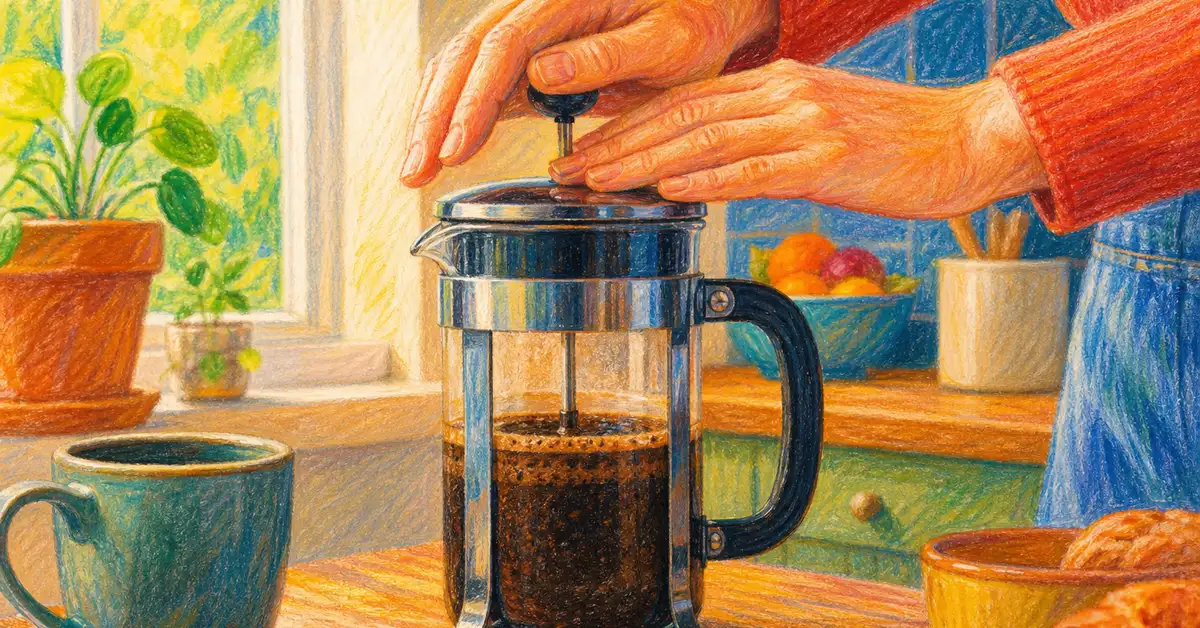
Apply steady, gentle downward pressure on the plunger — it should take about 20–30 seconds to fully press. If it resists strongly, your grind is too fine. If it drops with no resistance, grind is too coarse. Once pressed, pour all the coffee into cups or a carafe immediately — leaving brewed coffee sitting on top of the grounds causes over-extraction and bitterness, even with the plunger down.
Getting the Ratio Right: French Press Coffee to Water
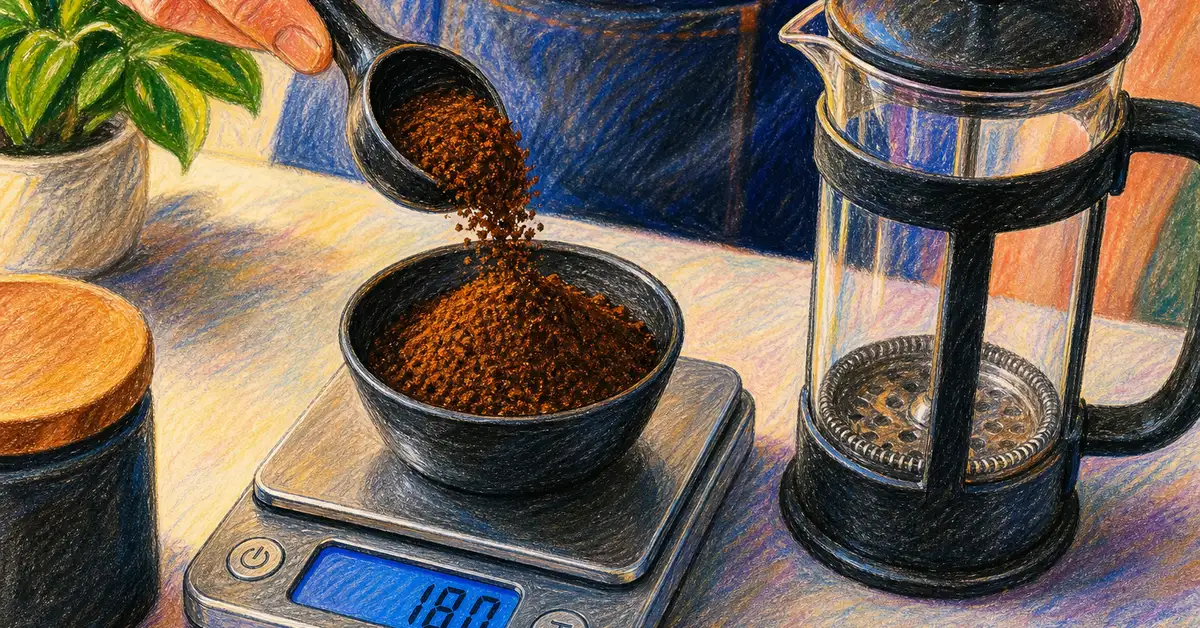
The coffee-to-water ratio is the single biggest lever you have for controlling brew strength. The standard starting point recommended by specialty coffee professionals is 1:15 by weight — 1 gram of coffee per 15 grams (millilitres) of water.
| Press Size | Water | Coffee (1:15) | Cups Yield |
|---|---|---|---|
| 12 oz (3-cup) | 300 ml | 20 g | 1–2 |
| 17 oz (4-cup) | 450 ml | 30 g | 2–3 |
| 34 oz (8-cup) | 900 ml | 60 g | 4–6 |
| 51 oz (12-cup) | 1350 ml | 90 g | 8–10 |
To brew stronger, use a 1:12 or 1:13 ratio. To brew lighter, move toward 1:17. What you should not do is compensate for a weak brew by extending steep time — that route leads to bitterness. Adjust ratio, not time, to change strength.
What Grind Size for French Press?
French press requires a coarse grind — one of the coarsest settings on any grinder. Visually, the particles should resemble coarse sea salt or coarsely cracked black pepper. They should feel gritty between your fingers, not powdery or fine.
Why Grind Size Matters in French Press
Too fine → grounds pass through the metal mesh → gritty, over-extracted, bitter cup. Too coarse → grounds don't extract fully → thin, sour, weak cup. The coarse grind is calibrated to the 4-minute steep: fine enough to extract flavor, coarse enough to sit cleanly below the mesh.
Why coarse? Because the metal mesh filter in a French press has relatively large openings compared to a paper filter. A finer grind creates two problems: particles pass through the mesh into your cup (sediment), and the greater surface area of finer grounds extracts much faster — leading to bitter over-extraction in a 4-minute steep. Coarse grounds extract more slowly and stay below the mesh.
For grind size context across all brewing methods, see our complete coffee grind size chart.
Common French Press Mistakes (and How to Fix Them)
Most bad French press coffee comes from one of five fixable mistakes:
❌ Grind too fine
Symptom: Gritty cup, bitter aftertaste, plunger hard to push. Fix: Move to coarser grind setting. If using a blade grinder, pulse for less time.
❌ Water too hot or too cold
Symptom: Scorched, harsh taste (too hot) or flat, sour taste (too cold). Fix: Use 195–205°F. If boiling, wait 30–45 seconds before pouring.
❌ Leaving coffee in the press after plunging
Symptom: Cup that tastes fine initially but becomes bitter as it sits. Fix: Pour everything immediately after pressing. If you're not drinking it all at once, transfer to a carafe.
❌ Wrong ratio (too much or too little coffee)
Symptom: Weak, watery cup or overwhelmingly strong, astringent cup. Fix: Weigh your coffee. Start at 1:15 and adjust from there.
❌ Dirty press
Symptom: Stale, musty, or rancid flavor underneath the fresh coffee. Fix: Rinse immediately after every brew. Deep clean weekly — old coffee oils go rancid and will contaminate every subsequent cup.
How to Adjust Your French Press Brew to Taste
Once you've nailed the baseline recipe, use this troubleshooting map to dial in your preferred cup:
| Taste Problem | Likely Cause | Fix |
|---|---|---|
| Bitter / harsh | Over-extracted: grind too fine, steep too long, or water too hot | Coarsen grind first; reduce steep by 30 sec; check temp |
| Sour / thin | Under-extracted: grind too coarse, steep too short, or water too cold | Grind slightly finer; steep 30 sec longer; raise temp |
| Weak / watery | Not enough coffee | Increase ratio to 1:13 or 1:12; do not extend steep time |
| Too strong | Too much coffee | Move toward 1:16 or 1:17 ratio |
| Gritty / muddy | Grind too fine; pressing too fast | Coarsen grind; press slowly over 20–30 sec |
Not sure which French press to use?
Our research-led guide covers the best French presses for every budget and cup size.
How to Clean a French Press
Coffee oils go rancid quickly, and a dirty French press is one of the most common reasons for consistently mediocre-tasting cups. Here's the minimum cleaning routine:
After Every Brew
- Discard grounds (compost, not drain — clogs pipes)
- Rinse the carafe, plunger, and mesh with hot water
- Leave disassembled to air-dry
Weekly Deep Clean
- Fully disassemble the plunger and mesh screens
- Soak all parts in warm, soapy water for 10–15 min
- Scrub the mesh with a soft brush
- Rinse thoroughly and dry
Most French press carafes — whether glass, stainless, or ceramic — are dishwasher safe on the top rack. The mesh filter benefits from an occasional soak in a baking-soda-and-water solution to dissolve built-up oils.
French Press vs. Drip vs. Pour-Over: Quick Comparison
Understanding where French press sits relative to other common brewing methods helps you know when it's the right tool — and when it isn't.
| Method | Body | Skill Level | Time | Best For |
|---|---|---|---|---|
| French Press | Full, rich, oily | Beginner+ | ~6 min | Relaxed mornings; bold drinkers |
| Drip Machine | Medium, clean | Beginner | 5–10 min | Convenience; multiple cups |
| Pour-Over | Light, clean, complex | Intermediate | ~4–5 min | Single origin; bright flavor |
| Espresso | Intense, concentrated | Advanced | ~2–3 min | Espresso drinks; milk-based |
French press is the best entry point into manual brewing — it's forgiving, requires no paper filters, and produces a noticeably richer cup than most automatic drip machines. When you're ready to explore further, check our guide to the best coffee makers or browse the full home coffee gear guide.
Frequently Asked Questions
How long should I steep French press coffee?
4 minutes is the standard steep time for French press and is a reliable starting point for most coffees and grind sizes. If your cup tastes sour or weak, steep for 4.5–5 minutes. If it tastes bitter, try reducing to 3–3.5 minutes. Time is a secondary adjustment — fix grind and ratio first.
Why is my French press coffee bitter?
Bitterness in French press usually means over-extraction: the grind is too fine, the steep is too long, or the water is too hot. Start by coarsening your grind — that's the most common culprit. Then verify your water temperature is 195–205°F, not boiling. Also check that you're pouring all the coffee out immediately after pressing, not leaving it on the grounds.
What is the best coffee-to-water ratio for a French press?
The specialty coffee industry consensus is 1:15 by weight — 1 gram of coffee per 15 grams (millilitres) of water. For a standard 34 oz (8-cup) press, that's roughly 60 g coffee to 900 ml water. If you prefer stronger coffee, try 1:13 or 1:12. If you prefer lighter, try 1:17. Adjust ratio, not steep time, to change strength.
Do I need a scale to use a French press?
You don't need one, but a scale produces more consistent results than measuring by volume. A common volume approximation is 2 tablespoons of ground coffee per 6 oz of water, though this can vary depending on grind coarseness and bean density. If you brew French press regularly, a basic kitchen scale (entry-band pricing) is one of the easiest upgrades you can make.
What coffee beans work best in a French press?
Medium-dark and dark roasts work particularly well in French press because the immersion method and metal filter preserve and amplify coffee oils, producing a rich, satisfying body. Light roasts can work but tend to taste thinner and more acidic through a French press — pour-over or drip tends to suit them better. For beans, look for ones described as "full-bodied," "chocolatey," or "nutty" — these flavor profiles shine through French press brewing.
How do I reduce sediment in my French press coffee?
Some sediment is normal in French press — it's part of the character of the method. To minimize it: grind coarser (fewer fine particles to pass through the mesh), press slowly (20–30 seconds), and let the cup sit for 30–60 seconds before drinking (fines sink to the bottom). Avoid disturbing the last third of the cup. If you want a completely sediment-free cup, pour-over with a paper filter is a better fit.
Ready to Upgrade Your French Press?
Our research-led guide covers the best French presses of 2026 — from compact glass to insulated travel-ready stainless steel.
Sources: Specialty Coffee Association — Coffee Standards; National Coffee Association USA, National Coffee Data Trends 2024; Immersion brewing extraction research: Corrochano, L.M. (ed.), Advances in Chemical Engineering, Science of Coffee series; Perger, M., Barista Hustle, "Coffee Extraction and How to Taste It" (2023). Market data: Grand View Research, Coffee Machine Market Report (2025). Specialty coffee brewing principles referenced from SCA Brewing Control Chart methodology.