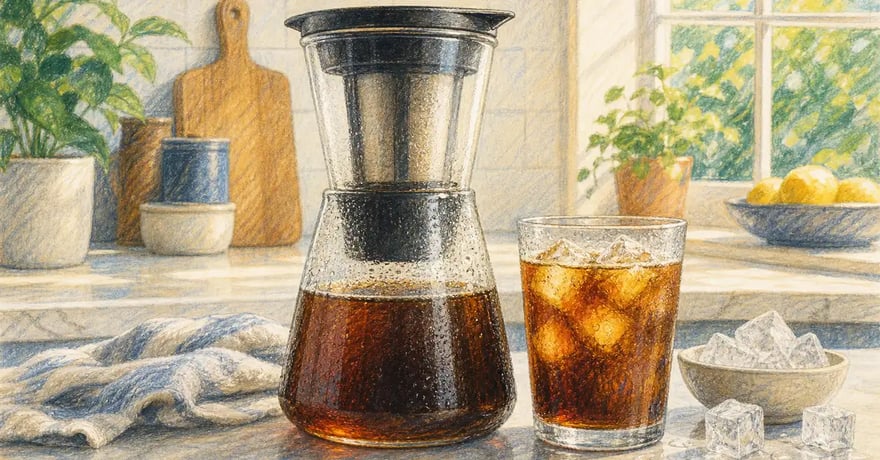
The OXO Good Grips 32 oz Cold Brew Coffee Maker is the best cold brew coffee maker for most home users in 2026 — its rainmaker lid, stainless mesh filter, and lever-drain carafe make a consistently smooth concentrate with almost no fuss. If you want large-batch concentrate, go with the Toddy or Filtron. If you want cold brew in 30 minutes, the DASH Rapid or Vinci Express deliver. And if counter space is tight, the Hario Mizudashi or Primula Burke do the job beautifully at entry-band pricing.
Price tiers are relative to this guide: $ = budget · $$ = mid · $$$ = premium · $$$$ = high-end.
We researched 12 cold brew coffee makers across every price band and brew style — immersion, slow-drip, and rapid circulation — consulting editorial tests from Food Network, Food & Wine, and specialty coffee sources. Here's what we found.
⚡ Quick Picks
- Best overall: OXO Good Grips 32 oz Cold Brew Coffee Maker
- Best large-batch concentrate: Toddy Cold Brew System
- Best for heavy users: Filtron Cold Water Brewer
- Best rapid cold brew: DASH Rapid Cold Brew Maker
- Best compact: Hario Mizudashi Cold Brew Coffee Pot
- Best budget: Primula Burke Cold Brew Coffee Maker
- Best for design lovers: KitchenAid Cold Brew Coffee Maker
- Best slow-drip: Hario Shizuku
What Makes a Cold Brew Coffee Maker Worth Buying?
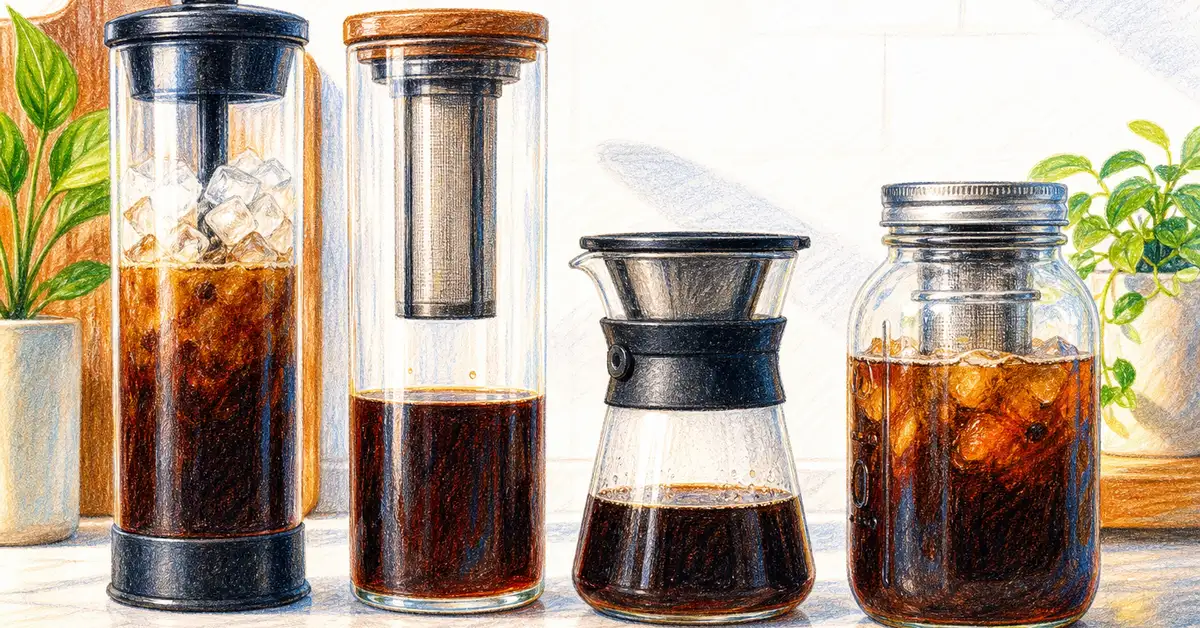
Cold brew's rise from specialty café novelty to everyday staple has produced an unusually rich ecosystem of dedicated brewers. The core chemistry is simple: steeping coarsely ground coffee in cold water for 12–24 hours extracts a smoother, lower-acid concentrate than hot brewing — with some devices marketing results as up to 65% less acidic than hot-brewed coffee.
But not all cold brew makers are equal. Three system types dominate in 2026:
- Immersion brewers — submerge grounds in cold water; steep 12–24 hours; most consistent and forgiving (OXO, Toddy, Filtron, Hario Mizudashi, Primula, Takeya, County Line Kitchen)
- Slow-drip / Kyoto-style — water drips slowly over grounds; brews in 1–2 hours; cleaner flavor, more ceremony (Hario Shizuku)
- Rapid circulation — pump or agitation cuts steep time to 15–45 minutes; speed at some cost to traditional mouthfeel (DASH Rapid, Vinci Express)
Beyond system type, the key differentiators are filtration quality (mesh vs. felt vs. paper — affects sediment and clarity), capacity (compact 1L carafes vs. 50 oz concentrate systems), concentrate vs. ready-to-drink (do you want to dilute, or drink straight?), and material (glass, stainless, BPA-free plastic).
How We Evaluated These Cold Brew Makers
We synthesized 2024–2026 editorial tests from Food Network, Food & Wine, and specialist cold brew sources, cross-referencing manufacturer specifications and Stumptown Coffee's brewing guidance. We did not physically test these products. Price bands reflect general market positioning, not scraped live prices — always check current pricing before buying. Products are assessed on: filtration quality, capacity, ease of use, flavor consistency, and value.
The 12 Best Cold Brew Coffee Makers of 2026
1. OXO Good Grips 32 oz Cold Brew Coffee Maker
Best Overall · Mid-Range ($$$)
The OXO is the benchmark for reason: a perforated rainmaker lid distributes water evenly across the grounds bed, a central stainless steel mesh filter provides clean filtration, and a simple lever drains the concentrate directly into the glass carafe below. The result is consistently smooth cold brew with minimal sediment — and it sits in the refrigerator for a 12–24 hour steep without taking up awkward space.
Best for: Most households wanting reliable, hassle-free cold brew concentrate. Works equally well as a daily driver for couples or small families.
📦 Capacity: 32 oz concentrate | Filter: Stainless mesh | Steep time: 12–24 hours | Price band: Mid-range (~$$$)
✓ Pros: Even extraction, clean concentrate, intuitive lever drain, good capacity for 2–4 people, dishwasher-safe parts
✗ Cons: Not the cheapest option; concentrate format requires dilution step
Check Price on Amazon →2. Toddy Cold Brew System
Best Large-Batch Concentrate · Mid-Range ($$$)
The Toddy is the original home cold brew system, designed specifically to produce a rich concentrate that's stored in a glass decanter and diluted to taste over several days. Its felt filter system removes oils and fine particles, yielding an exceptionally clean, full-bodied extract — a profile Stumptown Coffee's head brewer specifically endorses for large-batch home production. The Toddy brews a substantial volume and is built to last for years.
Best for: Daily cold brew drinkers, households of 3–5, cold brew cocktail makers, anyone who wants a week's worth of concentrate in one brew.
📦 Capacity: ~1L+ concentrate | Filter: Felt / paper | Steep time: 12–24 hours | Price band: Mid-range (~$$$)
✓ Pros: Superior filtration (felt removes oils), great for concentrate batch-brewing, excellent flavor depth, long-lasting system
✗ Cons: Replacement felt filters are an ongoing cost; plastic brew bucket is less elegant than glass options
Check Price on Amazon →3. Filtron Cold Water Brewer
Best for Heavy Home Users · Mid-Range ($$$)
The Filtron is a heavyweight concentrate producer that brews approximately 50 oz of coffee extract from around 1 lb of coarsely ground coffee — one of the highest-capacity home systems available. Like the Toddy, it uses a felt pad filtration system for a clean, sediment-free concentrate. Stumptown Coffee and other specialty roasters specifically reference the Filtron as one of their top home cold brew equipment recommendations.
Best for: High-volume households, specialty coffee enthusiasts who want maximum extract per batch, and users who prioritize filtration quality over aesthetics.
📦 Capacity: ~50 oz concentrate | Filter: Felt + optional paper | Steep time: 12–24 hours | Price band: Mid-range (~$$$)
✓ Pros: Industry-endorsed, superior felt filtration, extremely high capacity, durable
✗ Cons: Less refined aesthetics; ongoing felt filter cost; takes up significant fridge space
Check Price on Amazon →4. DASH Rapid Cold Brew Coffee Maker
Best Rapid Cold Brew · Mid-Premium ($$$)
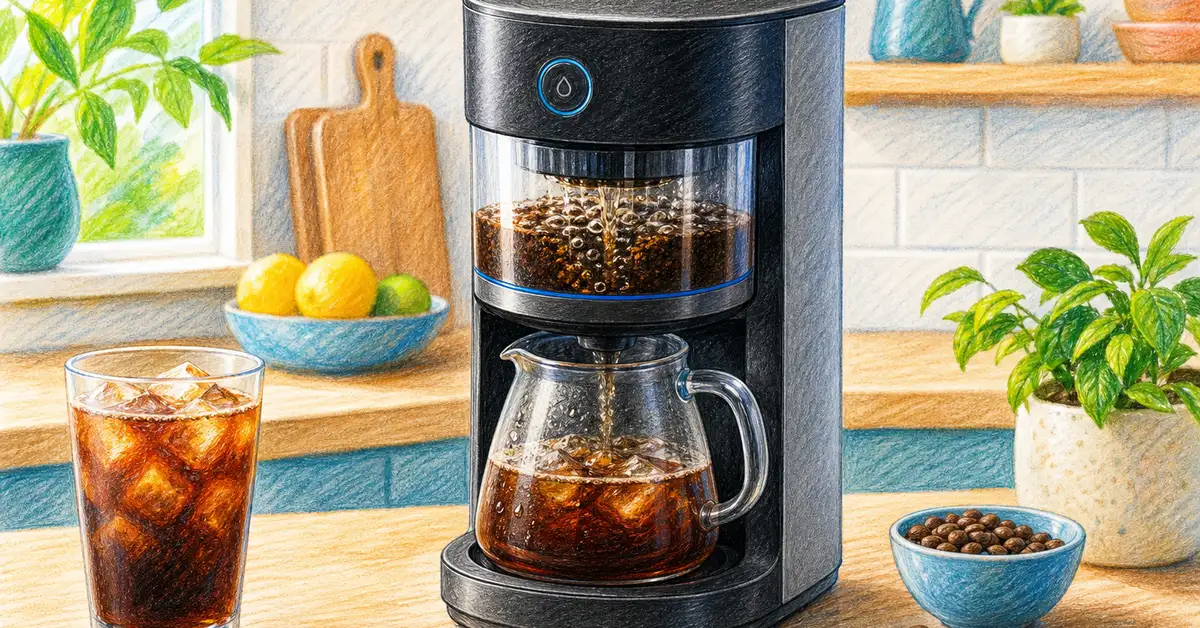
The DASH Rapid is among the most-tested rapid cold brew devices in 2025–2026 editorial panels, with Food Network reviewers noting it produces acceptable cold brew in as little as 15–45 minutes. It uses circulation rather than long steep time to accelerate extraction — ideal when you've forgotten to prep the night before. The trade-off: reviewers note the flavor profile can sit closer to strong iced coffee than classic cold brew, trading some of the mellow mouthfeel for speed.
Best for: Impatient cold brew lovers, spontaneous entertaining, or anyone who wants on-demand cold coffee without sacrificing dedicated hardware.
📦 Capacity: ~20–40 oz | System: Rapid circulation | Brew time: 15–45 minutes | Price band: Mid-premium (~$$$)
✓ Pros: Cold brew in minutes, no overnight planning needed, consistent results
✗ Cons: Flavor profile not identical to traditional 12-hour cold brew; costs more than simple immersion brewers; requires electricity
Check Price on Amazon →5. Hario Mizudashi Cold Brew Coffee Pot
Best Compact · Budget ($)
Hario's Mizudashi is a slim, elegant Japanese-style cold brew carafe designed to live in your refrigerator door. The central mesh basket holds coarse grounds while cold water surrounds it in the glass vessel — steep 8–24 hours, remove the basket, and your cold brew is ready to pour. Reviewers describe it as the easiest and most space-efficient cold brew pot for individuals and couples, widely praised by owners for its simplicity and clean flavor.
Best for: Individuals or couples with limited fridge space; anyone who wants Japanese aesthetics at a budget price.
📦 Capacity: ~1L ready-to-drink | Filter: Mesh basket | Steep time: 8–24 hours | Price band: Budget (~$)
✓ Pros: Slim fridge-door fit, Hario glass quality, incredibly simple, easy to clean, beautiful design
✗ Cons: Mesh basket won't match felt-filter clarity for heavy users; small capacity
Check Price on Amazon →6. Primula Burke Deluxe Cold Brew Coffee Maker
Best Budget Pick · Budget ($)
The Primula Burke is consistently one of the best-selling cold brew makers on Amazon, offering a durable glass carafe with protective silicone sleeve, comfort-grip handle, and removable mesh filter — all for around $. Primula markets it as producing cold brew that is up to 65% less acidic than hot coffee, and it's dishwasher and temperature-safe. Reviewers frequently praise the ergonomics and easy cleanup.
Best for: First-time cold brewers, budget buyers, or anyone wanting a simple, well-built glass immersion brewer without paying a premium.
📦 Capacity: ~1.6 qt (6 cups) | Filter: Removable mesh | Steep time: 12–24 hours | Price band: Budget (~$)
✓ Pros: Excellent value, silicone grip sleeve, dishwasher-safe glass, easy to use and clean
✗ Cons: Mesh filter not as refined as felt-filter systems; more sediment than OXO or Toddy
Check Price on Amazon →7. KitchenAid Cold Brew Coffee Maker
Best Design-Forward Option · Mid-Range ($$$$)
The KitchenAid cold brew maker (KCM4212SX / KCM5912SX) blends brand appeal with genuine brewing performance — stainless steel and glass construction, a mid-size ~38 oz capacity, and a steeping schedule that suits most households. Food Network reviewers placed it among the top picks in their 2025–2026 cold brew roundup. It suits design-conscious kitchens where aesthetics matter alongside function.
Best for: KitchenAid kitchen households; buyers who want a recognisable brand and attractive design over maximum capacity.
📦 Capacity: ~38 oz | Filter: Stainless/glass | Steep time: 12–24 hours | Price band: Mid-range (~$$$$)
✓ Pros: Premium aesthetics, solid build quality, good capacity for 2–3 people, strong brand support
✗ Cons: More expensive than comparable glass options; no felt filtration
Check Price on Amazon →8. Takeya Cold Brew Coffee Maker (Glass)
Best 2-Quart Budget Glass · Budget ($$)
Takeya's 2-quart borosilicate glass cold brew maker features an airtight BPA-free lid, silicone handle, and fine mesh infuser basket — a well-engineered budget option with thousands of positive reviews. The 2-quart size (roughly 1.9L) is larger than most glass carafes at this price, making it a strong value pick for households of 2–3. The borosilicate glass is notably more durable than standard glass.
Best for: Budget-conscious buyers who want a larger glass immersion brewer with an airtight seal.
📦 Capacity: 2 qt / ~1.9L | Filter: Fine mesh infuser | Steep time: 8–24 hours | Price band: Budget (~$$)
✓ Pros: Borosilicate glass, airtight lid, large 2-qt capacity, strong value, silicone handle
✗ Cons: Fine mesh may allow some sediment; plastic lid components on some variants
Check Price on Amazon →9. County Line Kitchen Glass Cold Brew Coffee Maker
Best Mason-Jar Style · Budget-Mid ($$)
County Line Kitchen's cold brew maker uses a heavy-duty wide-mouth mason jar-style glass carafe with a stainless steel mesh filter — no-fuss, durable, and easy to clean. The wide mouth makes it easy to add grounds and scrub clean. The 2-quart capacity brews a solid batch for a household, and the simple design is genuinely hard to break. If you like the mason jar aesthetic and want something more purposeful than a jar with a lid, this is it.
Best for: Rustic/minimal kitchen aesthetic; buyers who want easy cleaning and a wide-mouth design.
📦 Capacity: ~2 qt | Filter: Stainless mesh | Steep time: 12–24 hours | Price band: Budget-mid (~$$)
✓ Pros: Heavy-duty glass, easy to clean, wide mouth, simple and reliable
✗ Cons: Mesh filter allows some sediment; less refined than engineered systems
Check Price on Amazon →10. Vinci Express Cold Brew Coffee Maker
Best Rapid Alternative · Mid-Premium ($$$$)
The Vinci Express Cold Brew is the DASH Rapid's main competitor in the rapid circulation category, using its own pump-and-flow system to cut steep time to minutes rather than hours. Food Network and Food & Wine have both included it in their 2025–2026 rapid cold brew roundups, noting that while it sacrifices some of the traditional mouthfeel of slow-immersion cold brew, it outperforms a standard mug of iced coffee in smoothness and character.
Best for: Speed-focused users who want dedicated rapid cold brew hardware with a different design than the DASH.
📦 System: Rapid circulation | Brew time: ~15–25 minutes | Price band: Mid-premium (~$$$$)
✓ Pros: Fast cold brew without traditional wait, decent flavor for the speed, compact design
✗ Cons: Not identical to 12-hour immersion in mouthfeel; more expensive than immersion options
Check Price on Amazon →11. Hario Shizuku Slow-Drip Cold Brew Maker
Best Slow-Drip (Kyoto-Style) · Mid-Range
The Hario Shizuku is one of the few Kyoto-style slow-drip brewers available for home use at an accessible price. Cold water drips slowly over coffee grounds, percolating through and collecting in a lower carafe over 1–2 hours — considerably faster than immersion systems, and producing a cleaner, more aromatic cold brew with less body. The borosilicate glass construction is characteristically Hario. This isn't for speed seekers, but for those who appreciate the ritual and the lighter flavor profile.
Best for: Specialty coffee enthusiasts; light roast fans; anyone drawn to the ceremony of slow-drip brewing.
📦 Capacity: 600ml | System: Slow drip / Kyoto-style | Brew time: 1–2 hours
✓ Pros: Cleaner, more aromatic cold brew; no overnight wait; beautiful Hario glass; unique experience
✗ Cons: Small 600ml capacity; requires calibrated drip rate; more fragile than immersion systems
Check Price on Amazon →12. OXO Brew Compact Cold Brew Coffee Maker
Best Compact OXO · Mid-Range ($$)
The OXO Compact is a smaller sibling to the full-size OXO Good Grips, bringing the same rainmaker lid and quality engineering to a more apartment-friendly footprint. Stumptown Coffee specifically endorses it alongside the Filtron as one of their top home cold brew equipment picks. For households where counter and fridge space is at a premium but OXO quality is non-negotiable, this is the one to get.
Best for: Small kitchens and apartments; OXO loyalists who need a compact footprint without compromising on filtration quality.
📦 Capacity: ~16 oz concentrate | Filter: Stainless mesh | Steep time: 12–24 hours | Price band: Mid-range (~$$)
✓ Pros: OXO quality at a smaller size, rainmaker lid, endorsed by Stumptown, fridge-friendly
✗ Cons: Lower capacity than the full-size OXO; not ideal for households of 3+
Check Price on Amazon →Cold Brew Coffee Maker Comparison Table
| Maker | System | Capacity | Steep Time | Filter | Price Band |
|---|---|---|---|---|---|
| OXO Good Grips 32 oz | Immersion | 32 oz conc. | 12–24 hrs | S/S mesh | ~$$$ |
| Toddy | Immersion | 1L+ conc. | 12–24 hrs | Felt/paper | ~$$$ |
| Filtron | Immersion | 50 oz conc. | 12–24 hrs | Felt | ~$$$ |
| DASH Rapid | Rapid circ. | 20–40 oz | 15–45 min | Integrated | ~$$$ |
| Hario Mizudashi | Immersion | ~1L RTD | 8–24 hrs | Mesh basket | ~$ |
| Primula Burke | Immersion | 1.6 qt | 12–24 hrs | Mesh | ~$ |
| KitchenAid | Immersion | ~38 oz | 12–24 hrs | S/S glass | ~$$$$ |
| Takeya Glass | Immersion | 2 qt | 8–24 hrs | Mesh infuser | ~$$ |
| County Line Kitchen | Immersion | ~2 qt | 12–24 hrs | S/S mesh | ~$$ |
| Vinci Express | Rapid circ. | 20–40 oz | 15–25 min | Integrated | ~$$$$ |
| Hario Shizuku | Slow drip | 600ml | 1–2 hrs | Gravity | Mid-range |
| OXO Compact | Immersion | 16 oz conc. | 12–24 hrs | S/S mesh | ~$$ |
Concentrate vs. Ready-to-Drink: Which Type Is Right for You?
One of the biggest decisions in choosing a cold brew maker is whether you want to brew a concentrate (to dilute) or a ready-to-drink batch (drink straight or over ice). This choice drives which device you need.
Concentrate brewers (Toddy, Filtron, OXO Good Grips) use a high coffee-to-water ratio — roughly 1:4 to 1:8 by mass — to produce a strong extract that you dilute 1:1 or 1:2 with water or milk before serving. You get maximum flexibility: the same concentrate works in iced lattes, cold brew cocktails, or straight over ice. Felt-filter systems like Toddy and Filtron are purpose-built for concentrate because they handle high-dose brews without clogging.
Ready-to-drink brewers (Hario Mizudashi, Primula Burke, Takeya) use ratios closer to 1:12–1:15, similar to filter coffee. You pour directly over ice and drink it as-is. These systems are simpler and better suited to casual drinkers who don't want to think about dilution. The trade-off: you brew less volume (typically 1–2 quarts rather than a large concentrate batch), and you'll be brewing more often if you drink cold brew daily.
How to Make Great Cold Brew Coffee: The Fundamentals
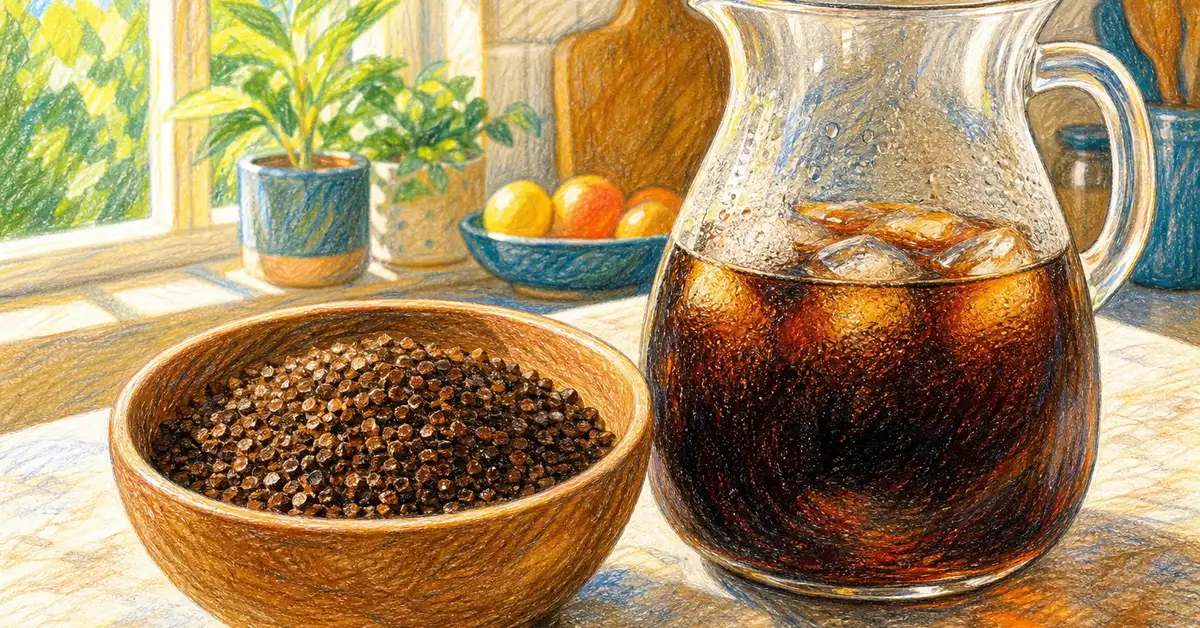
Getting great cold brew is less about equipment and more about fundamentals. According to Stumptown Coffee's head brewer, these are the variables that matter most:
Grind size: Extra-coarse is the standard for immersion cold brew — about the texture of raw sugar or coarsely cracked peppercorns. This reduces fine particles (which cause sediment and over-extraction) and allows even extraction over long steep times. Rapid brewers can tolerate slightly finer grinds, but still avoid anything approaching filter or espresso grind territory.
Brew ratio: For concentrate (Toddy, Filtron, OXO): aim for roughly 1:4 to 1:8 (coffee to water by mass), then dilute 1:1 or 1:2 at serving. For ready-to-drink (Hario Mizudashi, Primula): target 1:12 to 1:15, similar to filter coffee ratios. A practical starting point is 1 oz (28g) of coffee per 8 oz (240ml) of water for a medium-strength ready-to-drink cold brew.
Steep time and temperature: Cold-steep in the refrigerator (around 35–40°F) for 12–24 hours for most immersion systems. Longer steeps extract more depth but risk bitterness if your grind is too fine. Some guidance allows room-temperature steeps for the first phase, but always refrigerate the finished concentrate promptly — particularly if you're adding milk or sweeteners.
Filtration: The filter type significantly affects the final cup. Felt filters (Toddy, Filtron) remove oils and fine particles, producing the cleanest concentrate. Stainless mesh (OXO, Takeya) is excellent but allows slightly more body-contributing oils through. Rapid systems use integrated filters that vary by device.
Storage: Cold brew concentrate keeps for up to two weeks in the refrigerator in an airtight container. Ready-to-drink batches are best consumed within 7–10 days. Always use a sealed container — cold brew absorbs refrigerator odors.
Want to nail the grind?
Getting your cold brew grind right starts with a good burr grinder. See our guide to the best coffee grinders of 2026 for the gear that makes cold brew (and every other method) taste better.
Coffee Grind Size Chart →Immersion vs. Rapid Cold Brew: Which System Should You Choose?
The choice between immersion and rapid cold brew comes down to how you actually drink cold brew — and how much planning you're willing to do.
Choose immersion (OXO, Toddy, Filtron, Hario Mizudashi, Primula) if: you can plan a day ahead, you want the smoothest and most traditional cold brew flavor, you brew in batches to last several days, and you want the widest range of price points from ~$ to ~$$$.
Choose rapid circulation (DASH Rapid, Vinci Express) if: you forgot to prep the night before, you want cold coffee in under an hour, you don't mind a slightly different flavor profile (closer to strong iced coffee than classic cold brew), and you're comfortable spending more on the hardware.
Choose slow-drip (Hario Shizuku) if: you're a specialty coffee enthusiast who appreciates ritual and clean, aromatic brews, and you're happy with a smaller 600ml batch at a time.
For most people, the OXO Good Grips 32 oz hits the sweet spot: it's an engineered immersion brewer at a fair price, with genuinely superior filtration and a thoughtful design. Pair it with a coarse grind, a 14-hour fridge steep, and a 1:1 dilution and you'll have café-quality cold brew at home for pennies a cup.
Cold Brew Coffee Maker FAQs
Ready to Dial In Your Home Coffee Setup?
Explore the rest of our home coffee gear guides — from the best grinders to the best espresso machines.
Home Coffee Gear Guide → Best Coffee Makers →Sources: Food Network — Best Cold Brew Coffee Makers, Tested and Reviewed (2026) · Food & Wine — Best Cold Brew Coffee Makers (2026) · Stumptown Coffee — Cold Brewing FAQs · That's Cold Brew — Toddy vs Filtron vs OXO comparison how to make cold brew coffee at home best coffee beans for cold brew