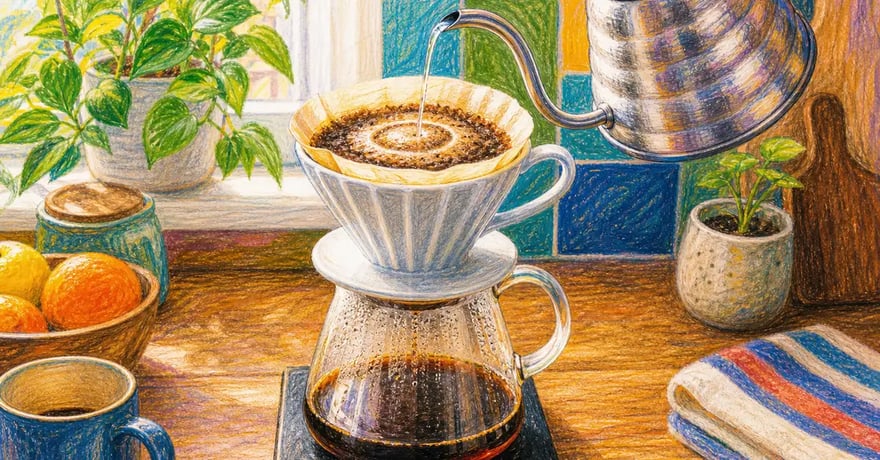
Quick answer: Use a 1:16 ratio (e.g., 25g coffee to 400g water), grind medium-fine, rinse your filter, bloom with twice the coffee's weight in water for 30–45 seconds, then pour in slow spirals over 3–4 minutes total. Water temperature: 200°F / 93°C (about 30 seconds off the boil).
Pour-over coffee produces some of the cleanest, brightest cups you can make at home — a method that rewards attention with remarkable clarity of flavor. Whether you're using a Hario V60, a Kalita Wave, or a Chemex, the fundamentals are the same: controlled water flow, the right temperature, and a steady hand. This guide covers everything from your first pour to fixing the most common mistakes.
What You'll Need
- A pour-over dripper (Hario V60, Kalita Wave, or Chemex — all work with this method)
- Paper filter (sized to your dripper)
- A gooseneck kettle — essential for precise, controlled pouring
- A kitchen scale accurate to 1g
- A timer (your phone works)
- Freshly ground coffee, medium-fine grind
- Water heated to 200°F / 93°C
On grinders: Pour-over highlights grind consistency more than almost any other method. A burr grinder — even an entry-level hand grinder — will noticeably improve your cup compared to blade-ground coffee. That said, a good pre-ground specialty coffee will still produce an excellent pour-over.
How to Make Pour-Over Coffee: Step-by-Step
Step 1: Set Up and Rinse Your Filter
Place the paper filter in your dripper and set it over your mug or carafe. Pour hot water through the filter — about 100ml is enough. This rinse does two things: it removes the papery taste that filter paper can impart to the coffee, and it preheats the dripper and vessel. Discard the rinse water, then place your dripper back on the vessel and set both on your scale. Tare (zero) the scale.
Step 2: Grind and Add Coffee
Grind your coffee to medium-fine — roughly the texture of coarse sand or raw sugar. For a single cup, start with 25g of coffee. This will produce approximately 375–400ml of brewed coffee at a 1:16 ratio, a good starting point for most palates.
Add the ground coffee to the filter and gently tap the dripper to level the bed. A flat, even bed of coffee ensures water flows through uniformly. Zero your scale again after adding the coffee.
Ratio guide: Prefer a stronger cup? Try 1:15 (25g coffee, 375g water). Prefer lighter? Use 1:17 (25g coffee, 425g water). Keep notes on what you like.
Step 3: The Bloom Pour
Start your timer. Pour twice the weight of your coffee in water: for 25g of coffee, pour 50g of water. Pour in a slow, even spiral from the center outward, making sure to wet all the grounds. You'll see the coffee bed bubble and rise — this is CO₂ releasing from freshly roasted beans. Stale coffee doesn't bloom; a good bloom means fresh coffee.
Wait 30–45 seconds. This bloom phase allows CO₂ to escape before the main brew, preventing it from creating uneven extraction pathways through the grounds.
Step 4: The Main Pour
Pour in stages, aiming to add roughly 60–80g of water every 30–45 seconds. Pour in slow, controlled spirals — start at the center and move outward, then back inward. Avoid pouring directly onto the filter paper or the edges, where water can bypass the grounds entirely.
Keep the water level below the top of the filter. A gentle, steady spiral maintains what brewers call "agitation" — the swirling motion keeps fresh water in contact with the grounds for even extraction. Aggressive pouring or dumping large amounts of water at once produces uneven, muddy results.
Continue until you've poured your total water weight. For 25g coffee at 1:16, that's 400g total (including the 50g bloom).
Step 5: The Drawdown
When you've added all your water, let the coffee drain through the filter completely. A well-brewed pour-over should finish its drawdown at 3:00 to 4:00 minutes total brew time. If it takes longer than 4:30, your grind is too fine — coarsen it slightly next time. If it finishes before 2:30, the grind is too coarse — go finer.
Once the drip slows to a stop, remove the dripper. Your coffee is ready.
Step 6: Taste, Adjust, Repeat
Swirl the carafe or mug gently before drinking. Pour-over coffee brewed correctly should taste clean, bright, and distinctly of the bean — floral or citrus notes in light roasts, chocolate and stone fruit in medium roasts. If it's bitter, the grind is too fine or the water too hot. If it's sour or underdeveloped, the grind is too coarse or the water too cool.
Pour-Over Tips for a Better Cup
6 Tips for Better Pour-Over Coffee
- Always rinse the filter — it genuinely removes papery taste and takes 20 seconds.
- Weigh coffee and water — tablespoons and cups are imprecise. An inexpensive kitchen scale transforms your consistency.
- Use a gooseneck kettle — a regular kettle pours too fast and too wide. The gooseneck's narrow spout gives you control that makes a real difference.
- Don't rush the bloom — a full 45-second bloom pays off in a more even extraction.
- Target total brew time of 3:30 — adjust grind coarseness to hit this window.
- Use freshly roasted beans — pour-over is unforgiving of stale coffee. Look for a roast date within the last 3–4 weeks.
Troubleshooting Pour-Over Problems
| Problem | Likely Cause | Fix |
|---|---|---|
| Bitter, harsh taste | Over-extracted: grind too fine, water too hot, or brew too long | Coarsen grind; lower water temp to 195°F |
| Sour, underdeveloped taste | Under-extracted: grind too coarse, water too cool, or brew too fast | Fine up the grind; use hotter water; slow your pour |
| Draws down too slowly (>4:30) | Grind too fine; or filter clogged with fines | Coarsen grind; pour more slowly to reduce fines migration |
| Draws down too quickly (<2:30) | Grind too coarse or water added too fast | Fine up the grind; slow your pour rate |
| Uneven/channeled extraction | Coffee bed not flat; water not distributed evenly | Level the bed before brewing; use steady spiral pours |
How We Researched This Guide
Pour-over brewing parameters in this guide are consistent with SCA brewing protocols and widely accepted specialty coffee standards for ratio, temperature, and extraction time. We don't operate a physical testing lab — these recommendations are research-led and grounded in the principles of how water extracts coffee compounds at different temperatures, grind sizes, and flow rates.
Ready to Choose a Dripper?
See our research-led picks for the best pour-over coffee makers of 2026 — V60s, Kalita Waves, Chemex, and electric options compared at every price point.
See the Best Pour-Over Makers →Frequently Asked Questions About Pour-Over Coffee
What's the best ratio for pour-over coffee?
A 1:16 ratio (1g coffee to 16g water) is a reliable starting point and produces a clean, balanced cup. Specialty coffee associations generally recommend 1:15 to 1:17 depending on roast level and personal preference. Lighter roasts often benefit from a slightly more concentrated ratio (1:15), while medium roasts are well-balanced at 1:16. Adjust by taste from there.
What temperature should the water be for pour-over?
200°F / 93°C is the sweet spot — about 30 seconds off the boil if you don't have a temperature-controlled kettle. Water below 195°F tends to under-extract, producing sour, underdeveloped coffee. Water above 205°F can over-extract delicate flavors in light roasts. Temperature-controlled gooseneck kettles eliminate this variable entirely.
Does the pour-over dripper type matter?
Yes, but less than grind size and ratio. The V60 (single large hole) requires more pour control; the Kalita Wave (flat bed, three small holes) is more forgiving; the Chemex (thick paper filter) produces a very clean cup by removing more oils. All three can produce excellent coffee. Beginners often find the Kalita Wave easiest to achieve consistent results with.
How fine should I grind pour-over coffee?
Medium-fine — roughly the texture of coarse sugar or sea salt. This is finer than drip coffee but coarser than espresso. If your coffee draws down in under 2:30, go finer. If it takes more than 4:30, go coarser. Total brew time of 3:00 to 4:00 minutes is the target. Use this as your calibration window.
Do I need to buy expensive coffee for pour-over?
You don't need expensive coffee, but you need fresh coffee. Pour-over amplifies both the strengths and weaknesses of your beans — a specialty single-origin light roast will taste extraordinary, but stale grocery store beans will taste flat regardless of your technique. Fresh medium roasts from a local roaster in the mid-range price band produce genuinely excellent pour-overs without breaking the bank.
Sources: Specialty Coffee Association Brewing Protocols; Hario V60 and Kalita Wave product documentation; published extraction science references for water temperature and grind relationship in filter brewing.