Coffee Brewing Methods: The Complete Guide
There is no single best way to brew coffee at home — only the method that fits your taste, your time and your budget. This hub explains the main home brewing methods, how they differ, and points you to the right gear and step-by-step guide for each.
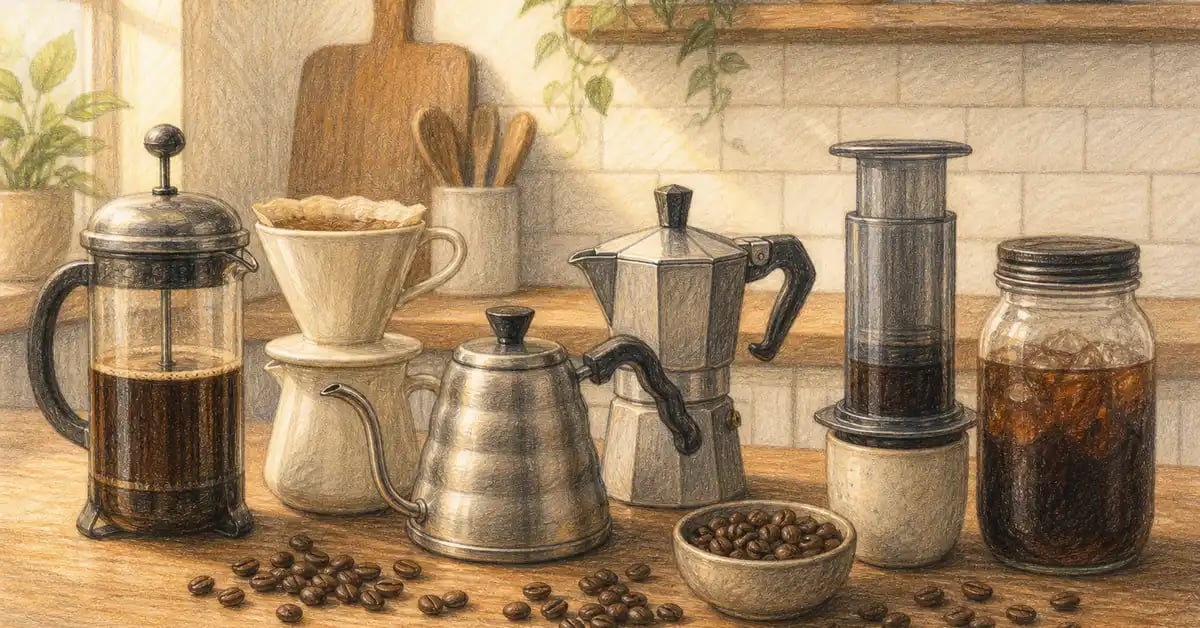
The five most popular manual methods — French press, pour-over, moka pot, AeroPress and cold brew — cover almost every taste, from rich and full-bodied to clean and bright to smooth and iced. Espresso sits in its own category (higher cost, higher ceiling), and automatic drip is the everyday workhorse. Our guides are research-led: we work from specialist publication consensus, manufacturer documentation and cross-checked owner feedback — we don't run a physical lab.
Start here: pick your method
Want espresso instead? See the Home Espresso guide. Shopping for the gear that makes all of these better? Start with the Home Coffee Gear guide, and for beans and subscriptions see the Beans and Subscriptions hub.
How to choose your brew method
Think about three things — flavor, effort and cost:
Flavor. Want a clean, bright cup that shows off a single-origin coffee? Choose pour-over. Prefer a rich, heavy body? French press or moka pot. Want smooth, low-acid iced coffee? cold brew. Espresso is the base for milk drinks like lattes and cappuccinos.
Effort. Immersion methods (French press, cold brew) are the most forgiving — coffee just steeps. Pour-over rewards a little technique and a gooseneck kettle. The AeroPress is fast and flexible once you find a recipe.
Cost. A French press, pour-over dripper or cold-brew jar is one of the most budget-friendly ways in; a moka pot is inexpensive too. Espresso is the biggest investment once you add a machine and a capable grinder — and whichever method you choose, a good burr grinder does more for your cup than almost anything else.
Match the method to how you drink
If you drink one cup in the morning and value ease, a French press or AeroPress fits. If you love the ritual and chase flavor clarity, pour-over is the hobby that keeps giving. If you drink iced coffee all summer, keep a jar of cold brew in the fridge. And if milk drinks are your thing, espresso (or a moka-pot shortcut) is the way in. Whatever you pick, buy whole beans, grind fresh, and dial in your ratio. See our coffee-to-water ratio guide for the exact numbers by method.
Frequently asked questions
What is the easiest coffee brewing method?
French press and cold brew are the most forgiving. Both are immersion methods — coffee simply steeps in water — so there's no pouring technique to master. French press gives you a hot cup in about four minutes; cold brew is effortless but needs 12–24 hours of patience.
Which brewing method makes the strongest coffee?
By concentration, espresso and the moka pot make the most intense coffee, followed by cold-brew concentrate before dilution. Immersion and pour-over methods produce a lighter-bodied cup. Strength also depends on your coffee-to-water ratio, so any method can be made bolder.
Which method makes the best-tasting coffee?
There's no single winner — it depends on the flavor you want. Pour-over highlights clarity and bright, delicate notes; French press and moka pot deliver body and richness; cold brew emphasizes smooth sweetness and low acidity. The best method is the one that matches your taste and the time you'll actually spend.
What's the difference between immersion and pour-over brewing?
In immersion brewing (French press, cold brew, AeroPress) the coffee sits fully submerged in the water for the whole brew. In pour-over (V60, Kalita, Chemex) water passes through a bed of grounds and drains away continuously. Immersion is more forgiving; pour-over gives more control and clarity.
Which brewing method is cheapest to start?
A French press or a simple pour-over dripper are both budget-friendly, and cold brew can be made in any jar. Moka pots are inexpensive too. Espresso is the most expensive entry point once you add a machine and a capable grinder.
Reader-supported. Café Grade earns a commission when you buy through links on our guides, at no extra cost to you — it never changes our picks. Our recommendations are research-led, not based on physical testing.