The best pour-over coffee maker for most people is the Hario V60 Plastic (Size 02) — inexpensive, forgiving once you learn the basics, and used by world-class baristas at every level. But pour-over is also the most opinion-driven category in coffee: flat beds vs. cones, ceramic vs. plastic, full immersion hybrids vs. pure drip. This guide cuts through it so you can choose the right dripper for how you actually brew.
Price tiers are relative to this guide: $ = budget · $$ = mid · $$$ = premium · $$$$ = high-end.
Pour-over coffee works by pouring hot water through freshly ground coffee in a filter, letting gravity draw the liquid through and into a vessel below. Unlike immersion methods (French press, AeroPress), pour-over is continuous-flow: water contacts grounds for a shorter, more controlled time. The result — when done well — is clean, bright, and expressive of the bean's origin character. Specialty Coffee Association research confirms that paper-filtered pour-over removes most diterpenes (oils linked to LDL effects), making it one of the healthier brewing methods.
⚡ Quick Picks
- Best overall: Hario V60 Plastic (02) — the universal standard
- Best for beginners: Kalita Wave 185 Stainless — forgiving flat-bed
- Best for set-and-walk-away: Clever Dripper — full immersion, then drain
- Best for clarity + batch brew: Chemex 6-Cup — makes up to 30 oz
- Best immersion hybrid: Hario Switch — V60 with a bottom valve
- Best premium: Fellow Stagg X — precision ridges, built-in ratio guide
- Best for travel: Orea Brewer V3 — ultra-light, skeletal design
- Best aesthetic: Origami Dripper — Japanese ceramic, dual filter compatibility
Which Pour-Over Dripper Should You Buy?
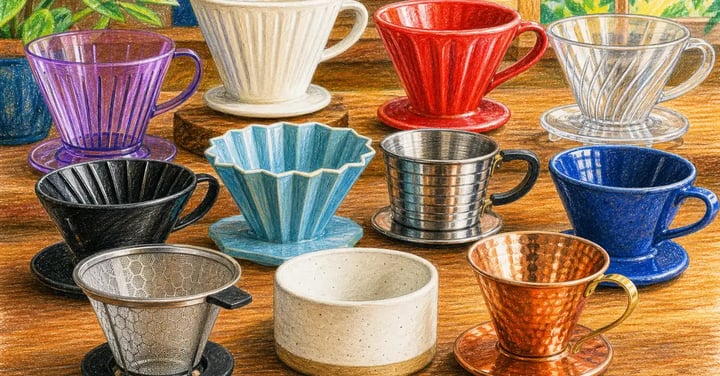
The most important buying question isn't brand — it's cone vs. flat-bed and how much technique you want to apply.
Cone drippers (V60, Fellow Stagg X, Orea, Origami) have a single large opening at the bottom. Water flows fast, which rewards good pouring technique but punishes inconsistency. They produce the highest clarity and the most expressive flavor at their best. They're what most specialty coffee shops use and what championship competitors choose. The learning curve is real but not steep — a few weeks of practice with a scale and timer is enough.
Flat-bed drippers (Kalita Wave, Bee House) have multiple small holes across a flat bottom. Water pools briefly, creating a more even extraction that's more forgiving of grind inconsistencies and pour speed. They produce slightly less brightness than cones but are excellent for beginners and those who want consistency over maximised clarity.
Immersion-switch hybrids (Clever Dripper, Hario Switch) add a valve that holds water in contact with the grounds until you decide to drain. This combines full-immersion flavor development with paper's clean filter clarity. It's the most forgiving category — closer to a manual coffee maker than traditional pour-over.
The 10 Best Pour-Over Coffee Makers Reviewed
1. Hario V60 Plastic (Size 02) — Best Overall
Best overall · Budget (~$)
The V60 has been the benchmark dripper in specialty coffee for over a decade and it's not close. Its single spiral rib and open 60° cone let water flow freely, rewarding good technique with exceptional clarity and brightness. The plastic version is the smart buy: it's lighter than ceramic, pre-warms faster (less heat absorption), is virtually unbreakable, and produces identical coffee to the more expensive glass or ceramic versions when recipes are matched. Popular Mechanics calls it "the gold standard" in independent testing. Size 02 fits 1–4 cups (20–700ml); size 01 suits single cups only.
Best for: Anyone who wants to learn pour-over properly and brew the best-tasting coffee possible.
✓ Pros
- Widest filter availability (tabs + no-tab)
- Fastest heat-up vs. ceramic/glass
- Unbreakable for daily use
- Huge recipe community + tutorials
✗ Cons
- Higher skill ceiling — punishes poor pours
- Plastic (fine; just not premium-looking)
Capacity: 1–4 cups · Filter: V60 02 paper · Material: Polypropylene · Price band: Budget (~$)
Check Price on Amazon →2. Chemex 6-Cup — Best for Batch Brewing and Clarity
Best for 2–4 people · Mid-range (~$$$)
The Chemex is a 1941 design that's still in production — a one-piece hourglass borosilicate glass carafe with a wooden collar and rawhide tie. It uses bonded Chemex filters that are 20–30% thicker than standard V60 filters, removing more oils and fine particles for an exceptionally clean, tea-like cup. The 6-cup model brews up to 30 oz — comfortably enough for 2–4 people in one batch. The Chemex has been exhibited in the MoMA permanent collection since 1944. One key note: Chemex filters are unique to the Chemex and cost more than standard V60 filters.
Best for: Households brewing for multiple people who want an iconic design and the cleanest possible cup.
✓ Pros
- 30 oz capacity for batch brewing
- Thicker filters = exceptional clarity
- All-in-one brewer + carafe (no separate vessel)
✗ Cons
- Proprietary filters cost more
- Glass — fragile; handle with care
- Longer brew time (5–7 min for full batch)
Capacity: Up to 30 oz · Filter: Chemex bonded (proprietary) · Material: Borosilicate glass · Price band: Mid-range (~$$$)
Check Price on Amazon →3. Kalita Wave 185 (Stainless Steel) — Best for Beginners
Best beginner-friendly · Mid-range (~$$)
The Kalita Wave uses a flat-bed extraction with three small drain holes and a spring-wave filter that holds the paper away from the walls. This design creates a controlled, even flow that's significantly more forgiving than cone drippers — minor variations in grind size or pour rate have less impact on the final cup. The 185 is the two-cup size (recommended); the 155 is for single cups. The stainless version won't break and is easier to travel with than ceramic. For anyone new to manual coffee who wants consistent results without a steep learning curve, the Wave is the right starting point.
Best for: Pour-over beginners, V60 converts who want more forgiveness, and brewers who prioritize consistency.
✓ Pros
- Flat-bed = more forgiving extraction
- Stainless steel — virtually indestructible
- Consistent results even with imperfect pours
✗ Cons
- Wave filters less widely stocked than V60
- Slightly lower ceiling vs. V60 for experts
Capacity: 2–4 cups · Filter: Kalita Wave 185 · Material: Stainless steel · Price band: Mid-range (~$$)
Check Price on Amazon →4. Clever Dripper — Best for French Press Lovers
Best immersion-filter · Budget-mid (~$$)
The Clever Dripper is the least technique-dependent pour-over on this list. Its valve mechanism holds water and grounds in full immersion until you place it on a mug or carafe — gravity then opens the valve and draining begins. You get the full body and extraction of immersion brewing filtered through a paper cone for clarity. It's the easiest transition for French press drinkers who want to try paper-filtered coffee without learning a whole new pouring technique. Uses standard size-4 cone filters (widely available). Capacity is about 18 oz (1–3 cups). The Spruce Eats rates it highly for ease of use.
Best for: French press and AeroPress drinkers wanting paper-filtered clarity without mastering pour technique.
✓ Pros
- Easiest technique of any dripper here
- Full immersion for body + paper for clarity
- Uses standard #4 cone filters
✗ Cons
- Not traditional pour-over — more like a valve brewer
- Lower clarity ceiling than V60/Chemex
Capacity: ~18 oz · Filter: #4 cone (Melitta/generic) · Material: BPA-free plastic · Price band: Budget-mid (~$$)
Check Price on Amazon →5. Hario Switch (Size 02) — Best Immersion Hybrid for V60 Fans
Best V60 immersion upgrade · Mid-range (~$$$)
The Hario Switch is a V60 with a silicone valve added to the bottom — open the switch and it flows like a traditional V60; close it and grounds steep in full immersion. This gives you total control over extraction: you can do a pure immersion brew (close all the way through, then open to drain), a hybrid (bloom open, then close for steep, then open), or pure flow (leave open throughout). It uses standard V60 filters, fits any V60 server, and has become a championship-level tool for its versatility. If you already own a V60 and want to expand your technique, the Switch is the natural upgrade.
Best for: V60 users who want immersion control; anyone experimenting with James Hoffmann-style recipes.
✓ Pros
- V60 filter compatibility
- Three brew modes in one dripper
- High ceiling for expert recipes
✗ Cons
- Glass — more fragile than stainless options
- Not the best entry-level choice
Capacity: 1–4 cups · Filter: V60 02 paper · Material: Glass + silicone valve · Price band: Mid-range (~$$$)
Check Price on Amazon →6. Fellow Stagg X Dripper — Best Premium Pour-Over
Best premium · Premium (~$$$$)
The Fellow Stagg X is the most refined cone dripper on the market — double-walled stainless steel with precision ridges that radiate heat evenly outward, preventing temperature loss during long brews. A built-in ratio aid shows the recommended coffee-to-water ratio by volume as you add grounds. The Fellow EG-1 grinder community consider it a standard-setter for extracting maximum clarity from light roasts. At ~$$$, it's the most expensive dripper on this list, but it's the one serious home baristas keep after trying everything else. Fellow's technical writeup details the thermal mechanics behind the ridged design.
Best for: Enthusiast home baristas who want the highest ceiling for light-roast specialty coffee.
✓ Pros
- Precision ridges for even thermal distribution
- Built-in ratio indicator
- Double-wall stainless — excellent heat retention
✗ Cons
- Most expensive on this list (~$$$)
- Proprietary Fellow Stagg X filters recommended
Capacity: 1–4 cups · Filter: Fellow Stagg X (or compatible) · Material: Double-wall stainless · Price band: Premium (~$$$$)
Check Price on Amazon →7. Bee House Ceramic Dripper — Best Budget Ceramic
Best budget ceramic · Budget (~$)
The Bee House is the classic two-hole ceramic dripper that helped introduce many US specialty coffee shops to manual brewing in the mid-2000s. Its two small holes restrict flow enough to create a pooling effect similar to flat-bed drippers, making it more forgiving than a V60 while still producing excellent clarity. Uses standard Melitta #2 or #4 filters (widely available). Ceramic holds heat well but requires preheating and will crack if dropped. A solid, no-fuss option for anyone who wants ceramic heat retention at a reasonable price point.
Best for: Budget-conscious buyers who want ceramic's heat retention with a forgiving extraction.
✓ Pros
- Forgiving two-hole flow restriction
- Ceramic heat retention
- Standard Melitta filters (cheap and available)
✗ Cons
- Ceramic — fragile; must preheat
- Lower flavor ceiling vs. V60 for experts
Capacity: 1–3 cups · Filter: Melitta #2 or #4 · Material: Ceramic · Price band: Budget (~$)
Check Price on Amazon →8. Orea Brewer V3 — Best for Travel and Minimalists
Best travel pour-over · Mid-range (~$$$)
The Orea is the lightest full-featured dripper on this list — skeletal PETG plastic design that packs flat, weighs almost nothing, and brews championship-calibre coffee. It was designed by Australian barista Scott Rao and the Orea team for clarity and full compatibility with multiple filter types: it accepts Kalita Wave, CAFEC, and specially designed Orea filters. V3 adds improved flow control ridges and a flatter bed angle. Used by competitors in the World Brewers Cup. If pack weight matters (camping, travel, hostels), the Orea is the most serious brewer you can carry.
Best for: Travelers, hikers, and minimalists who want expert-level pour-over anywhere.
✓ Pros
- Ultra-light, packs flat
- Multi-filter compatibility
- Championship-calibre design
✗ Cons
- Higher price for a plastic brewer
- Less widely available in stores
Capacity: 1–3 cups · Filter: Orea / Kalita Wave / CAFEC · Material: PETG plastic · Price band: Mid-range (~$$$)
Check Price on Amazon →9. Origami Dripper — Best Aesthetic + Filter Versatility
Best Japanese ceramic · Premium (~$$$$)
The Origami is a hand-crafted Japanese ceramic dripper with 20 distinctive folds (hence the name) that hold the filter away from the walls and create even airflow during extraction. It's compatible with both V60 02 and Kalita Wave 185 filters — a rare dual-compatibility that gives it unusual flexibility. Available in multiple glazed colourways from Arita-yaki craftspeople; each piece is slightly unique. The Origami has been used in World Brewers Cup competitions and is a centrepiece brewer for those who treat their coffee equipment as objects worth displaying. Origami's own documentation describes the 20-fold engineering in detail.
Best for: Coffee enthusiasts who want beautiful equipment and V60/Wave filter flexibility in one dripper.
✓ Pros
- V60 + Kalita Wave filter compatible
- Stunning hand-crafted ceramic
- Championship-proven design
✗ Cons
- Premium price; not the best value brewer
- Ceramic — fragile; must preheat
Capacity: 1–4 cups · Filter: V60 02 or Kalita Wave 185 · Material: Arita-yaki ceramic · Price band: Premium (~$$$$)
Check Price on Amazon →10. Hario V60 NEO — Best Redesigned V60 with Wider Footprint
Best stable V60 variant · Budget-mid (~$)
Released in 2023, the V60 NEO is Hario's redesign of the classic — same spiral rib and 60° cone mechanics but with a wider, flatter base that fits more mug sizes and reduces the tipping risk that has frustrated V60 users for years. The NEO also has a slightly different filter design with improved compatibility. For anyone who loves the V60's flavor profile but found the original wobbly on small mugs or unusual vessels, the NEO solves that problem without adding cost. Uses standard V60 02 filters.
Best for: V60 fans who want better stability, or newcomers who plan to brew into various mugs and carafes.
✓ Pros
- Wider base = more stable on varied mugs
- Same V60 02 filter compatibility
- Budget price, V60 flavor
✗ Cons
- Still cone-dripper difficulty level
- Newer, so fewer recipe resources vs. original V60
Capacity: 1–4 cups · Filter: V60 02 paper · Material: Polypropylene · Price band: Budget-mid (~$)
Check Price on Amazon →Pour-Over Comparison Table
| Dripper | Type | Material | Filter | Capacity | Price Band | Best For |
|---|---|---|---|---|---|---|
| Hario V60 | Cone | Plastic | V60 02 | 1–4 cups | ~$ | Most people |
| Chemex 6-Cup | Cone | Glass | Chemex | Up to 30 oz | ~$$$ | Batch + clarity |
| Kalita Wave | Flat-bed | Stainless | Wave 185 | 2–4 cups | ~$$ | Beginners |
| Clever Dripper | Immersion | Plastic | #4 cone | ~18 oz | ~$$ | French press fans |
| Hario Switch | Hybrid | Glass | V60 02 | 1–4 cups | ~$$$ | V60 upgrade |
| Fellow Stagg X | Cone | Steel | Stagg X | 1–4 cups | ~$$$$ | Premium |
| Bee House | Flat-bed | Ceramic | Melitta #2/#4 | 1–3 cups | ~$ | Budget ceramic |
| Orea V3 | Cone | Plastic | Orea/Wave | 1–3 cups | ~$$$ | Travel |
| Origami | Cone | Ceramic | V60/Wave | 1–4 cups | ~$$$$ | Aesthetics |
| Hario V60 NEO | Cone | Plastic | V60 02 | 1–4 cups | ~$ | V60 stability |
Cone vs. Flat-Bed Drippers: What Actually Matters
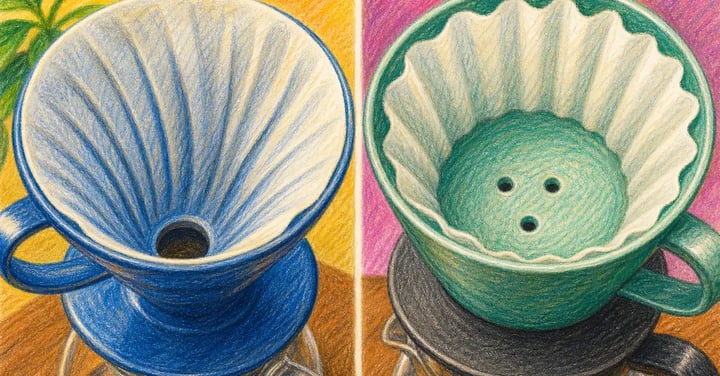
The cone-vs-flat-bed debate is the most hotly discussed topic in manual brewing forums, but the practical difference is smaller than the discourse suggests. Both types produce excellent coffee in capable hands. The meaningful differences come down to two things: flow rate control and extraction forgiveness.
Cones drain faster. A V60's single large opening drains at whatever rate your grind and pour allow — typically 2–3 minutes total for a standard recipe. This speed makes cones sensitive to grind size: grind too coarse and the water rushes through (underextracted, thin, sour); grind too fine and it stalls (overextracted, bitter). The payoff for managing this is the highest clarity and brightness when everything aligns.
Flat beds create a buffer. The Kalita Wave's three small holes slow drainage and create a brief pooling effect at the bottom of the bed, making flow rate less sensitive to small grind or pour variations. Extraction is slightly more uniform across the coffee bed. The trade-off is a subtle reduction in the peak clarity that the best cone recipes achieve.
For most home brewers, especially those who don't have a precision grinder, the Kalita Wave or Clever Dripper will deliver better results more consistently than a V60. The V60 is only better in absolute terms when used well — and "used well" requires a quality grinder, a gooseneck kettle, and attention to technique. See our best coffee grinder guide for the grinder half of this equation.
Pour-Over vs. Other Brewing Methods
Pour-over vs. French press: French press uses full immersion without a paper filter, letting natural oils and fine particles through into the cup. The result is heavier body and a texture some find satisfying — but also more sediment and roughly nine times the cafestol (a compound linked to LDL cholesterol) of filtered coffee, per SCA brew research. Pour-over's paper filter removes nearly all oils and most fines, producing a cleaner, brighter cup. If you love French press body, the Clever Dripper is the closest pour-over equivalent. See our best French press guide for the top options.
Pour-over vs. AeroPress: AeroPress also uses paper filtration but adds gentle pressure and full immersion, producing a lower-acid cup in 1–2 minutes. Pour-over is slower (3–5 minutes) and rewards more technique, but it's the preferred method for expressive, origin-forward coffees — particularly light roasts where clarity shows off terroir. AeroPress is faster, more forgiving, and better for one cup at a time. Our AeroPress comparison guide breaks down all 8 models.
Pour-over vs. automatic drip: A quality SCAA-certified drip machine (Technivorm Moccamaster, Breville Precision) can match pour-over in extraction quality and beats it on convenience. The advantage of pour-over is hands-on control — you can adjust your technique for each coffee batch. For anyone who wants the highest-quality automatic option, see our best coffee makers guide.
How to Brew Pour-Over Coffee: Step-by-Step
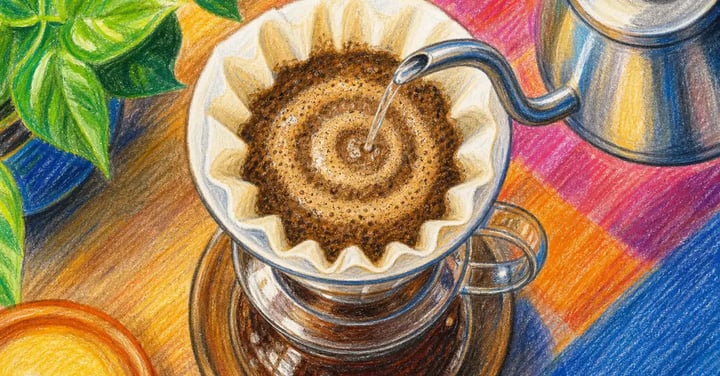
This is the standard V60 pour-over method — adaptable to any cone dripper. For flat-bed drippers, the same steps apply but total brew time may be 30–60 seconds longer. Use a gooseneck kettle if possible — it gives far more control over pour rate than a standard kettle.
You'll need: Dripper, paper filter, freshly ground coffee (medium-fine, ~15g for a single cup or ~30g for two cups), gooseneck kettle, scale, timer, and hot water (195–205°F / 91–96°C — slightly lower for darker roasts).
Step 1 — Rinse the filter. Place the filter in the dripper set over your mug or carafe. Pour hot water through to rinse and preheat everything — this removes papery taste and brings your vessel to brewing temperature. Discard the rinse water.
Step 2 — Add coffee and tare. Add your ground coffee (~15–30g depending on batch size) and tare the scale to zero.
Step 3 — Bloom. Pour twice the weight of your coffee in water (e.g., 30g water for 15g coffee) in slow circles starting from the center. Wait 30–45 seconds. This bloom releases CO2 from fresh coffee and ensures even saturation before the main pour. Beans roasted within 2–3 weeks bloom visibly; stale coffee barely blooms.
Step 4 — Pour in pulses. Pour the remaining water in 2–3 slow, steady circles (center to edge, never touching the filter walls). Aim for a 1:15 to 1:17 coffee-to-water ratio (15g coffee → 225–255g water). Keep the water level consistent — don't let the bed drain completely between pours.
Step 5 — Allow to drain. Total brew time: 2:30–3:30 for most V60 recipes, 3:00–4:00 for Chemex. When drainage stops and the bed is flat, your coffee is ready. A raised center bed or visible channelling means extraction was uneven — adjust grind or pour for next time. See our coffee grind size chart to dial in your starting grind.
Pour-Over FAQs
Do I need a gooseneck kettle for pour-over?
Not strictly — but it makes a significant difference. A gooseneck's narrow spout gives you precise control over pour rate and direction, which matters more for cone drippers (V60, Stagg X) than flat-bed ones (Kalita Wave, Clever Dripper). For beginners using a Clever Dripper, a standard kettle is fine. For V60 and serious cone brewing, a gooseneck is the highest-impact accessory you can buy.
What grind size should I use for pour-over?
Medium-coarse to medium for most drippers, with V60 users often going slightly finer (medium-fine) for more extraction. Start medium and adjust: if your brew drains in under 2 minutes and tastes thin or sour, grind finer. If it drains in over 4 minutes and tastes bitter, grind coarser. Our grind size chart has pour-over reference points for every dripper type.
What's the best coffee-to-water ratio for pour-over?
1:15 to 1:17 by weight (coffee:water) covers most preferences. 1:15 produces a stronger, more concentrated cup; 1:17 is lighter and more transparent. Start at 1:16 (15g coffee, 240g water) and adjust to taste. Avoid measuring by volume (scoops) — coffee density varies and weight is far more consistent.
Is pour-over coffee better than drip coffee?
"Better" depends on your priorities. Pour-over done well extracts more nuanced flavor from quality beans than most home drip machines — especially for light-roasted specialty coffees. But a quality automatic drip machine like a SCAA-certified brewer can match or exceed mediocre pour-over in consistency and speed. The real advantage of pour-over is control: you can adapt your technique to each coffee. See our best coffee makers guide if you prefer automatic brewing.
Which pour-over filters produce the cleanest cup?
Chemex filters are the thickest (20–30% denser than standard) and produce the cleanest, most oil-free cup. Standard V60 filters are next. Metal mesh reusable filters let the most oils through, producing a heavier body similar to French press. For maximum clarity on specialty light-roasts, paper always outperforms metal — the SCA and most specialty roasters recommend paper for analytical tasting.
Should I buy a V60 in plastic, ceramic, or glass?
Plastic, and don't overthink it. Independent controlled tests — including James Hoffmann's now-famous comparison video — show no distinguishable flavor difference between V60 materials when recipes are matched. Plastic pre-warms fastest (absorbs less heat), is unbreakable, and costs a fraction of ceramic or glass. The ceramic and glass versions cost more purely for aesthetics and texture. Buy plastic and spend the difference on better coffee.
Your Dripper Is Just the Start
A quality burr grinder makes more difference to your pour-over than any dripper upgrade. Fresh beans and consistent grind = the real game-changer.
Sources: Popular Mechanics — Best Pour-Over Coffee Makers; Serious Eats — Pour-Over Guides; Specialty Coffee Association — Brew Research; Manufacturer product pages (Hario, Kalita, Fellow, Chemex, Orea, Origami, 2024–2026). how to make pour-over coffee