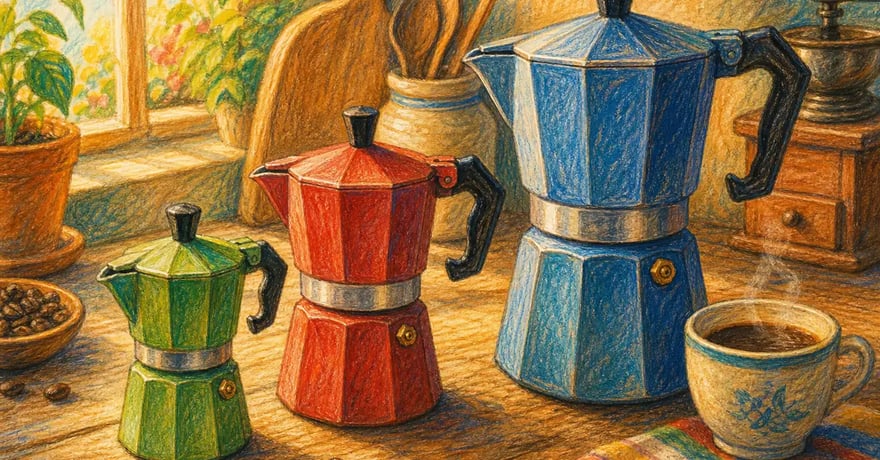
The best moka pot for most home brewers is the Cuisinox Roma — stainless steel, induction-compatible, and built to last decades. But the right moka pot depends on your stovetop type, how many cups you need, and how much you want to spend. This guide covers 10 of the best options across a range from the $ band to around $$$, with honest notes on what each one actually does well and where it falls short.
Price tiers are relative to this guide: $ = budget · $$ = mid · $$$ = premium · $$$$ = high-end.
Moka pots brew at roughly 1–1.5 bar of pressure — not true espresso's 9 bar, but enough to produce concentrated, aromatic coffee with real body and intensity. Invented by Alfonso Bialetti in 1933, the design has barely changed: a bottom water chamber, a middle grounds basket, and a top collection chamber. Simple, durable, and — with good technique — genuinely delicious.
⚡ Quick Picks
- Best overall: Cuisinox Roma (stainless, induction, Food & Wine pick)
- Best classic: Bialetti Moka Express 6-Cup (the original, $$)
- Best stainless for induction: Bialetti Venus
- Best for crema: Bialetti Brikka (pressure valve)
- Best budget: Primula Stovetop Espresso Maker ($)
- Best camping: GSI Outdoors Glacier Stainless
- Best premium design: Alessi Pulcina (~$$$$)
What to Look for in a Moka Pot
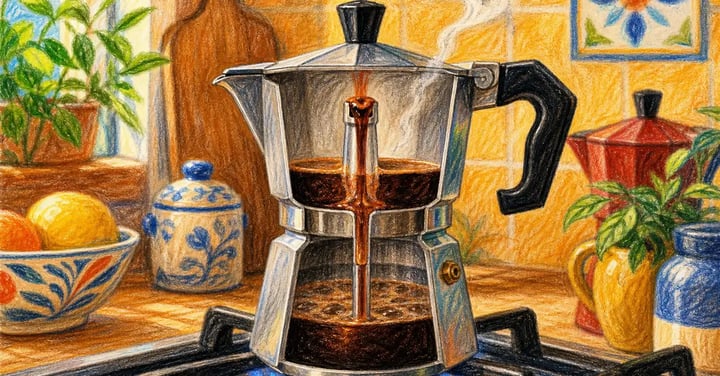
The moka pot market is dominated by Bialetti — the brand that invented the format — but a handful of other makers produce genuinely good alternatives. Here's what separates a moka pot worth buying from one that'll frustrate you:
Material: Aluminum is the traditional choice, lighter and a better heat conductor. Stainless steel is easier to clean, more durable, and — critically — induction-compatible. If you have an induction hob, you need stainless steel (or a stainless-bottomed pot). Aluminum works on gas, electric, and ceramic only.
Capacity: Moka pot "cups" are espresso-sized servings (roughly 1.5 oz/45ml each), not coffee mug portions. A "6-cup" moka pot makes about 9–10 oz of strong coffee — suitable for two large mugs or four espresso servings. Sizing up one level from what you think you need is usually the right move.
Safety valve: All reputable moka pots have a safety pressure release valve in the bottom chamber. Check it's present and unobstructed — it prevents pressure buildup if the grounds basket or filter get clogged.
Seal and gasket quality: The rubber gasket between the top and bottom chambers degrades over time. Replacement gaskets are widely available for Bialetti models. For less common brands, confirm replacements exist before you buy.
Handle comfort: You'll be gripping this under pressure (literally) while tilting it to pour. Phenolic (Bakelite-style) handles stay cool; some cheaper plastic handles don't.
The 10 Best Moka Pots of 2026
1. Cuisinox Roma — Best Overall
Best overall · Mid-Range to Premium (~$$$$)
The Roma is what happens when you take Bialetti's formula and apply better materials engineering. It's fully stainless steel, induction-compatible, and notable for its wider base — which gives you more contact with the heat source for even extraction. Food & Wine's 2026 test panel named it their top overall pick, citing consistent brew quality and durability. The lid swings open for easy filling; the handle stays genuinely cool. Gaskets and filters are replaceable.
Best for: Anyone on an induction hob; buyers who want to spend once and keep it 15+ years.
✓ Pros
- Induction-compatible
- Excellent build quality
- Wide base for even heat
- Dishwasher-safe
✗ Cons
- Pricier than Bialetti
- Less widely stocked in stores
Capacity: 6-cup · Material: Stainless steel · Induction: Yes · Price band: Mid-range to premium (~$$$$)
Check Price on Amazon →2. Bialetti Moka Express 6-Cup — Best Classic
Best classic · Budget (~$$)
The Moka Express is the moka pot. Designed by Alfonso Bialetti in 1933, it's sold hundreds of millions of units across 90+ years. The octagonal aluminum body, Bakelite handle, and eight-sided lid are as functional as they are iconic — the angles help you grip and pour. Aluminum heats faster than stainless and gives slightly different extraction characteristics (slightly more intense; some say slightly more metallic if not seasoned). Works on gas, electric, and ceramic — not induction. Available in 1, 2, 3, 4, 6, 9, and 12-cup sizes; the 6-cup is the most popular for home use.
Best for: Gas or electric hob users; anyone who wants the real deal with a century of proof behind it.
✓ Pros
- The definitive classic
- Excellent price-to-quality
- Wide range of sizes
- Parts universally available
✗ Cons
- Not induction-compatible
- Hand-wash only recommended
Capacity: 6-cup · Material: Aluminum · Induction: No · Price band: Budget (~$$)
Check Price on Amazon →3. Bialetti Venus 4-Cup — Best Stainless Steel (Induction-Compatible)
Best stainless for induction · Mid-range (~$$$)
Bialetti's answer to the stainless market. The Venus keeps the familiar Moka Express mechanism but wraps it in polished stainless steel, adding full induction compatibility. The cylindrical body looks more modern than the octagonal classic. Brew quality is comparable to the Moka Express — same basket, same filter plate, same pressure logic — just in a different material that's easier to keep clean. Available in 2, 4, 6, and 10-cup sizes; the 4-cup hits the sweet spot for one or two people.
Best for: Induction hob users who want Bialetti reliability without the premium price of the Cuisinox.
✓ Pros
- Induction-compatible
- Trusted Bialetti mechanism
- Easy to clean
✗ Cons
- Cylindrical body less grippy than octagonal
- Pricier than the Moka Express
Capacity: 4-cup · Material: Stainless steel · Induction: Yes · Price band: Mid-range (~$$$)
Check Price on Amazon →4. Bialetti Brikka 4-Cup — Best for Crema
Best for crema · Mid-range (~$$$)
The Brikka is the oddball in the Bialetti lineup — the only model with a pressure valve on the top chamber rather than the bottom. This valve restricts the coffee's exit, briefly raising pressure inside the top chamber and producing a thick, crema-like foam on the surface of your brew. It's not the same as espresso crema (which requires 9 bar), but it's noticeably richer-textured than standard moka pot output. Requires a slightly different technique: use a finer grind than the standard Moka Express. Available in 2 and 4-cup sizes; uses its own unique seal and gasket.
Best for: Home brewers who want the closest approximation to espresso-style output from a stovetop brewer.
✓ Pros
- Unique pressure valve for crema
- Richer, fuller-bodied output
- Available in 2-cup for solo use
✗ Cons
- Not induction-compatible (aluminum)
- Slightly more technique-sensitive
- Proprietary parts
Capacity: 4-cup · Material: Aluminum · Induction: No · Price band: Mid-range (~$$$)
Check Price on Amazon →5. Bialetti Musa 4-Cup — Best Slim Profile
Best slim design · Mid-range (~$$$)
The Musa is Bialetti's sleeker stainless option — taller and slimmer than the Venus, with a longer handle and a more contemporary look. Induction-compatible and dishwasher-safe (though hand-washing extends gasket life). The Musa's elongated form means it fits under cabinet-mounted kitchen spigots more easily than the wider Cuisinox Roma. Brew quality is consistent with other stainless Bialetti models. The longer handle is genuinely useful for maneuvering off the burner.
Best for: Induction hob users who want a leaner footprint and a more modern aesthetic.
✓ Pros
- Induction-compatible
- Slim, modern design
- Long comfortable handle
✗ Cons
- Slimmer base = potentially uneven heat on large burners
- Pricier than the Venus
Capacity: 4-cup · Material: Stainless steel · Induction: Yes · Price band: Mid-range (~$$$)
Check Price on Amazon →6. Grosche Milano Steel — Best Value Stainless
Best value · Budget to mid-range (~$$)
Canada-based Grosche makes genuinely good stainless moka pots at a price that competes with aluminum alternatives. The Milano Steel is induction-compatible, has a reliable safety valve, and comes in 3, 6, and 9-cup sizes. Grosche also has a social enterprise angle — each purchase funds clean water projects. Brew quality is solid; extraction is slightly more forgiving than the Bialetti mechanism at equivalent temperatures. Not as widely tested in editorial roundups as Bialetti, but user reviews are consistently strong.
Best for: Induction users who want stainless at a budget-closer price; buyers who care about brand ethics.
✓ Pros
- Induction-compatible at lower price
- Safety valve standard
- Multiple sizes available
✗ Cons
- Less editorial test coverage than Bialetti
- Replacement parts less readily available
Capacity: 3–9-cup · Material: Stainless steel · Induction: Yes · Price band: Budget to mid-range (~$$)
Check Price on Amazon →7. Primula Stovetop Espresso Maker — Best Budget
Best budget pick · Budget (~$)
If you want to try moka pot coffee before committing to a Bialetti, Primula's stovetop maker is a solid entry point. Aluminum body, standard safety valve, and the same basic three-chamber mechanics as the originals — at a fraction of the price. Build quality is noticeably lighter than Bialetti (thinner aluminum, lighter handle), and it won't last as long with heavy use. But for occasional use or to find out if you like moka pot coffee at all, it does the job. Not induction-compatible.
Best for: First-time moka pot buyers on a tight budget; occasional users.
✓ Pros
- Very affordable entry point
- Produces genuine moka pot coffee
- Widely available
✗ Cons
- Lighter build, shorter lifespan
- Not induction-compatible
- Replacement parts harder to find
Capacity: 3–6-cup · Material: Aluminum · Induction: No · Price band: Budget (~$)
Check Price on Amazon →8. Bialetti Moka Express 3-Cup — Best Compact
Best for 1–2 people · Budget (~$$)
The same iconic Moka Express — in 3-cup size. A 3-cup Bialetti makes roughly 4.5 oz of strong coffee: one generous cup, or two small espresso servings. If you're always brewing for yourself (or one other person), sizing down avoids the temptation to brew more than you need and then drink stale coffee. Note that moka pots work best when the grounds basket is full — so don't buy a 6-cup and try to use it half-full. The 3-cup is properly proportioned for solo use.
Best for: Single-person households; anyone who wants to brew one or two cups of moka pot coffee at a time.
✓ Pros
- Right-sized for solo brewing
- Same quality as 6-cup
- Compact storage
✗ Cons
- Not induction-compatible
- Produces very small volume — only one cup
Capacity: 3-cup · Material: Aluminum · Induction: No · Price band: Budget (~$$)
Check Price on Amazon →9. GSI Outdoors Glacier Stainless Espresso Maker — Best for Camping
Best camping pick · Mid-range (~$$)
The standard home moka pot isn't built for the trail — the glass lid, phenolic handles, and aluminum body can all be problematic in outdoor conditions. GSI Outdoors' stainless stovetop espresso maker is designed specifically for camp stoves and open flames: folding handle, rugged stainless construction, compact form factor. It brews in exactly the same way as any other moka pot, with the same three-chamber mechanism. Produces strong, concentrated coffee in 3-cup capacity. Works on gas and open flame; check GSI's specifications for induction compatibility on current models.
Best for: Backpackers, campers, and outdoor enthusiasts who want proper moka pot coffee away from home.
✓ Pros
- Built for outdoor use
- Rugged stainless construction
- Folding handle for compact packing
✗ Cons
- Overkill for home-only use
- Smaller output (3-cup)
Capacity: 3-cup · Material: Stainless steel · Induction: Check model specs · Price band: Mid-range (~$$)
Check Price on Amazon →10. Alessi Pulcina — Best Premium Design Pick
Best premium · Premium (~$$$$)
The Pulcina is Alessi's attempt to engineer a less-bitter moka pot through geometry, not gimmickry. Designed by Michele De Lucchi, it features a wider, flatter base (more surface contact with the hob), a slightly modified extraction timing via its unique spout shape, and a patented mechanism that stops extraction before the bitter last push of steam enters the upper chamber. The result, according to Alessi's testing, is coffee with less of the harsh finish that can make badly-made moka pot coffee unpleasant. The build is high-quality cast aluminum with a premium finish. It's a legitimate piece of Italian design history in addition to being a functional brewer.
Best for: Design-conscious buyers; anyone who finds standard moka pot coffee too harsh.
✓ Pros
- Engineered for smoother extraction
- Premium Italian design
- Available in 1, 3, and 6-cup
✗ Cons
- Not induction-compatible (aluminum)
- High price for an aluminum pot
- Proprietary parts
Capacity: 1, 3, or 6-cup · Material: Cast aluminum · Induction: No · Price band: Premium (~$$$$)
Check Price on Amazon →Moka Pot Comparison Table
| Moka Pot | Material | Induction | Capacity | Price Band | Best For |
|---|---|---|---|---|---|
| Cuisinox Roma | Stainless | ✓ Yes | 6-cup | ~$$$$ | Best overall |
| Bialetti Moka Express 6-Cup | Aluminum | ✗ No | 6-cup | ~$$ | Classic pick |
| Bialetti Venus 4-Cup | Stainless | ✓ Yes | 4-cup | ~$$$ | Induction stainless |
| Bialetti Brikka 4-Cup | Aluminum | ✗ No | 4-cup | ~$$$ | Crema/richer body |
| Bialetti Musa 4-Cup | Stainless | ✓ Yes | 4-cup | ~$$$ | Slim modern design |
| Grosche Milano Steel | Stainless | ✓ Yes | 3–9-cup | ~$$ | Value induction |
| Primula Stovetop | Aluminum | ✗ No | 3–6-cup | ~$ | Budget entry |
| Bialetti Moka Express 3-Cup | Aluminum | ✗ No | 3-cup | ~$$ | Solo brewing |
| GSI Outdoors | Stainless | Check model | 3-cup | ~$$ | Camping / outdoor |
| Alessi Pulcina | Cast aluminum | ✗ No | 1, 3, 6-cup | ~$$$$ | Premium / design |
Aluminum vs. Stainless Steel Moka Pots: Which Is Better?
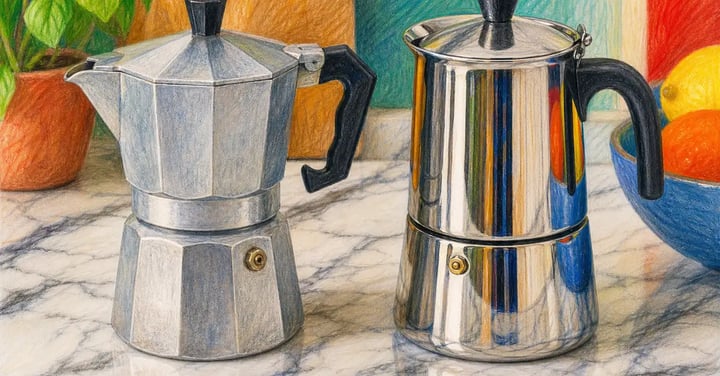
This is the most common question in moka pot buying and the answer is genuinely nuanced. Neither material produces universally better coffee — the differences are real but not dramatic:
Aluminum heats faster and more evenly due to higher thermal conductivity. Bialetti's aluminum pots have been the category reference for 90 years for good reason. The main drawbacks: aluminum can react slightly with acidic coffee over time (some people taste this as a faint metallic note in new, unseasoned pots), it's not dishwasher-safe, and — crucially — it won't work on induction cooktops. New aluminum moka pots should be "seasoned" by running a few brews through and discarding them before drinking.
Stainless steel heats slightly more slowly but holds heat well. It's induction-compatible, more durable over time, easier to clean, and taste-neutral (no metallic note, even with new pots). The main drawbacks: it costs more, and some users find it slightly less forgiving of temperature management on gas burners (it can overheat faster on high flame).
The practical decision: If you have an induction hob, choose stainless — there's no choice. If you're on gas, either works; aluminum is the traditional choice and slightly cheaper. If you're on electric or ceramic, both work equally well.
Moka Pot Size Guide: How Many Cups Do You Need?
Moka pot sizing is one of the most confusing parts of buying one, because manufacturers use "cups" to mean espresso-sized servings (approximately 40–50ml / 1.5 oz each) — not the 8 oz coffee mug portions most Americans think of. Here's what to actually expect:
| "Cup" Size | Actual Volume | Makes | Best For |
|---|---|---|---|
| 1-cup | ~1.5 oz / 45ml | 1 tiny espresso shot | Solo, tiny kitchen |
| 3-cup | ~4.5 oz / 135ml | 1 large cup or 2 small | 1–2 people |
| 6-cup (most popular) | ~9 oz / 270ml | 2 large mugs or 4 small | 2–3 people (best all-round) |
| 9-cup | ~13 oz / 390ml | 3 large mugs | Households of 3–4 |
Key rule: Always brew a full basket. Moka pots are designed to work with a full grounds basket — brewing half-batches changes the pressure dynamics and usually produces under-extracted, sour coffee. If you brew for one, buy a 3-cup. If you brew for two or three, the 6-cup is the standard recommendation.
How to Make Great Moka Pot Coffee: Step-by-Step

Moka pot technique is simple once you know the key variables. Most bad moka pot coffee comes from the same three mistakes: too-high heat, wrong grind, or tamping the grounds. Here's the correct approach, based on guidance from Homegrounds and Serious Eats:
Step 1 — Use pre-heated water. Fill the bottom chamber with hot (not boiling) water to just below the safety valve. Starting with hot water reduces the time the grounds are exposed to heat before extraction begins, which reduces bitterness.
Step 2 — Grind medium-fine. Coarser than espresso, finer than drip coffee. Think table salt or coarse sand. Too fine = over-extraction, bitter coffee. Too coarse = weak, sour output.
Step 3 — Fill the basket level, no tamping. Fill the grounds basket to the top and level it off with your finger. Do not tamp — moka pots need the water to push through the grounds loosely, not through a puck. Tamping causes over-pressure and bitter extraction.
Step 4 — Medium-low heat, lid open. Place on a medium-low flame or burner setting. Keep the lid open so you can watch the brew. A good moka pot brew is slow and steady — coffee should flow in a warm amber stream, not sputter and spit.
Step 5 — Remove from heat when you hear gurgling. When the stream becomes intermittent and you start hearing a bubbling/gurgling sound, the water in the bottom chamber is running out. Remove from heat immediately — the gurgling phase pushes bitter, steam-driven coffee into the top chamber.
Step 6 — Stop the extraction. Run the base briefly under cold water (or place it on a cold surface) to stop the residual heat from continuing to drive extraction. Pour immediately.
Moka Pot FAQs
Is moka pot coffee the same as espresso?
No — moka pot coffee is often called "stovetop espresso" but it's a different beverage. Moka pots brew at approximately 1–1.5 bar of pressure; true espresso machines operate at 9 bar. The result is strong and concentrated, but lacks the emulsified oils and true crema that 9-bar extraction produces. Think of it as its own thing: bolder than drip coffee, different from espresso.
Can I use a moka pot on an induction hob?
Only if it's stainless steel (or has a stainless-steel base). Aluminum is not magnetic and won't work on induction. The induction-compatible options in this guide: Cuisinox Roma, Bialetti Venus, Bialetti Musa, and Grosche Milano Steel. If you're not sure what hob you have, check whether a magnet sticks to your burner surface — induction tops attract magnets; electric and gas tops don't respond.
How do I know when to replace the gasket?
The rubber gasket seals the top and bottom chambers together. Replace it when you notice: coffee or steam leaking from the joint during brewing, the upper chamber taking significantly longer to fill, or when the gasket looks cracked, hardened, or compressed. Replacement gaskets for Bialetti Moka Express, Venus, and Brikka are widely available on Amazon — search for your specific model and size. Replace every 1–2 years with regular use.
Why does my moka pot coffee taste bitter?
The four most common causes: (1) Heat too high — use medium-low and reduce if coffee is sputtering; (2) Grind too fine — use medium-fine, not espresso-fine; (3) Letting the gurgle phase run — remove from heat at the first gurgle; (4) New aluminum pot — season it by running 2–3 brews through and discarding them. If none of these apply, try a lighter roast — medium roast generally works better in a moka pot than dark.
How do I clean a moka pot?
For aluminum moka pots: rinse with warm water only, no soap. Soap strips the seasoning that builds up over time and can leave a soapy taste in subsequent brews. Disassemble, rinse all three chambers plus the filter basket, and let air dry completely before reassembling. For stainless steel: mild dish soap is fine; rinse thoroughly. Never put aluminum moka pots in the dishwasher — the alkaline detergent oxidizes the metal.
What coffee should I use in a moka pot?
Medium roast works best — it has enough body for the concentrated output without the harshness that dark roast can produce at moka pot temperatures. Pre-ground coffee labeled "for stovetop espresso" or "moka pot" is usually milled at the right consistency. If you grind at home, aim for a setting between drip and espresso — most burr grinder scales put this around 3–5 on a 10-point scale. See our coffee grind size chart for a visual guide.
Building Your Home Coffee Setup?
Pair your moka pot with the right grinder and beans — our gear guides cover everything from entry-level to home barista setups.
Sources: Food & Wine — Best Moka Pots 2026; Serious Eats — Moka Pot Tips; Homegrounds — How to Use a Moka Pot; Bialetti, Cuisinox, Grosche, Alessi product specifications (manufacturer primary sources, 2026). how to use a moka pot