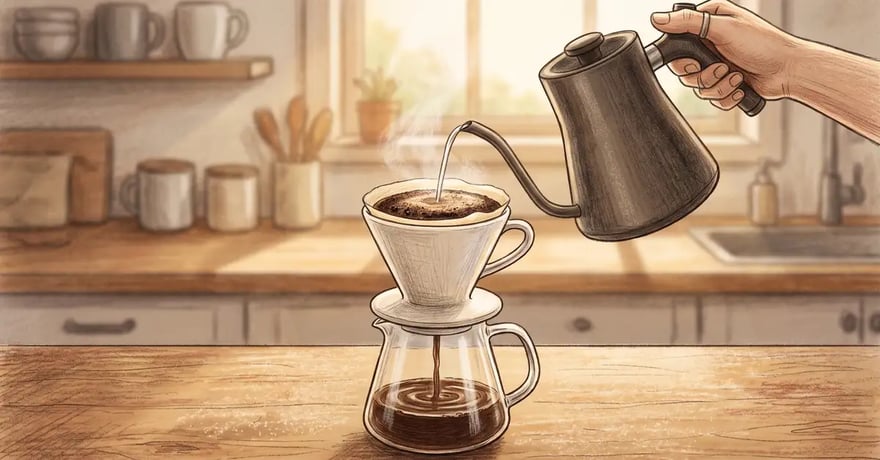
Pour-over is a manual brewing method where you pour hot water over ground coffee held in a filter cone, controlling the rate and pattern of the pour by hand. There's no pump, no auto-drip arm, no timer doing the work for you — you decide how fast the water goes in, where it lands, and how long the whole thing takes. That hands-on control is the entire point: it's what lets pour-over produce a clean, bright cup that a lot of people find hard to get from an automatic machine.
How pour-over works
Every pour-over follows the same basic sequence, whether you're using a cone dripper or a flat-bottomed one. First comes the bloom: a small pour — usually about twice the weight of your coffee dose in water — just enough to saturate the grounds. You wait 30 to 45 seconds while the coffee releases trapped CO₂ and visibly puffs up. Skip the bloom and that gas keeps escaping during the main pour instead, pushing water around the grounds unevenly and muting the cup.
After the bloom, you add the rest of the water in two or three slower stages, pouring in a gentle spiral from the center outward to keep the coffee bed saturated evenly, rather than dumping it all in at once. The goal is a steady, controlled drawdown — most recipes target somewhere around 2:30 to 3:30 minutes from your first pour to the last drop clearing the filter. If it drains faster than that, the grind is usually too coarse; slower than that, and it's too fine. Grind size is the main lever for dialing in that timing — see our coffee grind size chart for where pour-over sits relative to other methods. Getting a repeatable bloom and a consistent ratio also depends on weighing your coffee and water rather than eyeballing them — our best coffee scale guide covers the resolution and features that actually matter for pour-over dosing.
Pour-over vs. drip coffee maker vs. French press
| Pour-over | Drip coffee maker | French press | |
|---|---|---|---|
| Control | Full manual control of pour rate and pattern | Automated, minimal input | Minimal — mostly about steep time |
| Filter | Paper (or fine metal), clarifying | Paper, usually basket-style | Metal mesh — oils and fines pass through |
| Body/clarity | Clean, bright, tea-like clarity | Similar clarity, less pour control | Heavier, fuller body, more sediment |
| Best for | One or two cups, hands-on brewing | Larger batches, hands-off mornings | Full-bodied, low-effort immersion brewing |
A drip machine automates the same basic idea — hot water dripping through grounds in a filter — but you lose the ability to control pour rate, pattern, or bloom timing; see our best coffee makers guide if hands-off is what you want. French press works completely differently: it's full immersion, with grounds steeping directly in water and a metal mesh plunger instead of a paper filter, which lets more oils and fine particles through for a heavier, fuller-bodied cup — see our best French press picks. Pour-over sits at the hands-on, high-clarity end of the spectrum; the trade-off is that it asks more of you than either alternative.
Common pour-over devices
Most pour-over brewing happens with one of three dripper types. The Hario V60 is a cone with a single large drainage hole; it drains fast and rewards precise, deliberate pouring, typically with a medium-fine grind. The Kalita Wave has a flat bottom with three small holes, which spreads water more evenly across the coffee bed and makes it more forgiving of pouring inconsistencies — a common starting point for beginners, usually with a medium grind. The Chemex uses an extra-thick paper filter that catches more oils and fine particles, producing a noticeably cleaner, lighter cup than a V60 with the same coffee, and generally wants a medium-coarse grind. These are device types, not endorsements — for specific picks across budgets, see our best pour-over coffee maker guide.
Why people prefer it
The appeal is clarity and control: because you're directing the water yourself, you can taste the effect of a coarser grind, a slower pour, or a longer bloom in the very next cup, which makes pour-over a genuinely good way to learn what's actually happening during extraction. The resulting coffee tends to be brighter and more nuanced than drip or immersion brewing, which is why it's the house style at most specialty coffee bars. The honest trade-off: it's slower than pressing a button, it takes a few tries to get consistent, and you'll go through paper filters and probably want a gooseneck kettle and a scale to keep pours repeatable. If that sounds like more ritual than you want on a weekday morning, that's a fair reason to stick with drip or French press instead.
Getting started
If you don't have a dripper yet, our best pour-over coffee maker guide compares the main options across budgets. If you already own one and want the exact steps — water temperature, ratios, pour timing — our step-by-step how-to guide walks through a full brew start to finish. And since grind size is the single biggest variable in getting drawdown time right, our grind size chart is worth a look before your first attempt. For the wider landscape of brewing methods, start at the Brewing Methods hub.
Frequently Asked Questions
Is pour-over stronger than drip coffee?
Not necessarily stronger, but usually cleaner and brighter. Strength depends mainly on your coffee-to-water ratio, which you can match between the two methods — the real difference is that pour-over's manual control tends to produce a more nuanced, tea-like clarity than an automatic drip machine.
What grind size should I use for pour-over?
Medium to medium-fine, depending on your dripper — a V60 typically wants medium-fine, a Kalita Wave medium, and a Chemex medium-coarse. If your brew drains too fast or tastes sour and weak, grind finer; if it drains too slow or tastes bitter and harsh, grind coarser.
How long should pour-over take?
Most recipes target roughly 2:30 to 3:30 minutes total, from the first pour to the last drop clearing the filter. Consistently faster or slower than that range is the clearest sign your grind size needs adjusting.
Do I need a special kettle for pour-over?
You don't strictly need one, but a gooseneck kettle makes a real difference — its narrow spout gives you much finer control over pour rate and placement than a standard kettle, which makes it much easier to repeat a good pour.
Do I need a scale for pour-over?
You don't strictly need one, but it's the single biggest upgrade to consistency after a decent dripper. Weighing your coffee and water removes the guesswork that a measuring scoop introduces, and a scale with a fast, laggy-free display makes it much easier to hit your target bloom and pour times. See our best coffee scale guide for picks across budgets, including which ones are built specifically for pour-over's larger platform and pacing.
Pairing pour-over with decaf? Several of our best decaf coffee beans picks — including Swiss Water and sugarcane EA options — are specifically recommended for V60, Chemex and AeroPress brewing.
Weighing a V60 against other single-cup brewers? Our best AeroPress alternatives guide compares the Hario V60 Switch and other pour-over-style options against immersion and press brewers side by side.
Café Grade is research-led. This explainer draws on established brewing-technique references and manufacturer guidance for V60, Kalita Wave and Chemex brewing. Written by Michael Probert.