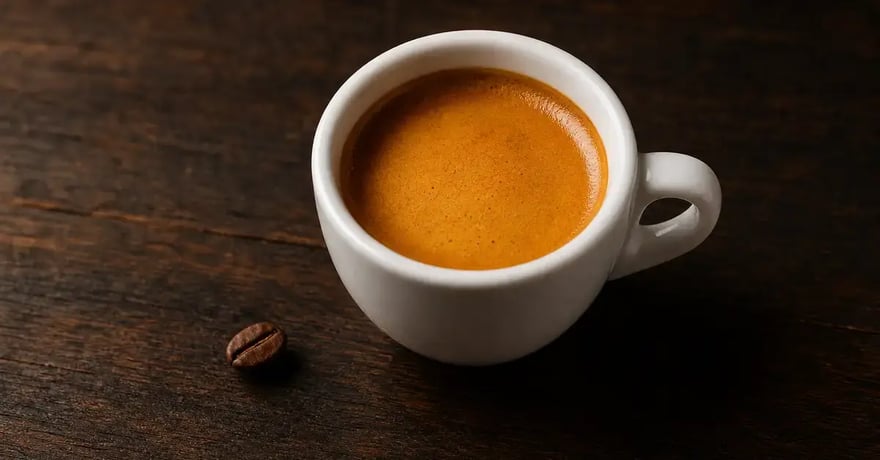
The espresso recipe that works for most coffees: 18 g of freshly ground coffee → 36 g of liquid espresso → in 25–35 seconds. That 1:2 ratio (dose to yield) is the starting point every well-respected coffee bar uses. Everything else — grind adjustment, dose tweaks, yield refinements — happens around this baseline.
This guide is a focused workflow reference — the recipe, the numbers, and what to do when a shot goes off. For detailed machine-operation steps (water tank, preheat, group head purge), see our how to use an espresso machine guide. For fixing sour or bitter shots systematically, see how to dial in espresso.
Adjust grind size to hit the time window. Adjust dose or yield for intensity once the grind is locked. Change one variable per session.
How to make espresso: the complete workflow
Preheat the machine and purge the group head
Switch the machine on 5–30 minutes before brewing, depending on type:
- Thermoblock machines (Breville Bambino, etc.): allow at least 1–2 minutes at idle — the group head needs time to stabilise even after the boiler is ready
- Single-boiler machines (Gaggia Classic Pro, Rancilio Silvia): 15–30 minutes for stable temperature throughout the group head
Before grinding, run a 3–5 second burst of hot water through the group head (without the portafilter) to flush residue and stabilise temperature. This step takes 10 seconds and consistently improves the first shot.
Grind 18 g of fresh coffee immediately before brewing
Set your burr grinder to your current espresso setting (or your established dial-in setting for this bag) and grind 18 g of coffee. Grind directly into the portafilter basket or into a dosing cup.
Two non-negotiables:
- Grind fresh: espresso-ground coffee stales within 5–10 minutes. Never pre-grind ahead of time.
- Use a burr grinder: blade grinders shatter beans into inconsistent sizes that make repeatable extraction impossible. If you're using a blade grinder and results are inconsistent, this is why. See our espresso grinder guide.
Distribute evenly, then tamp flat with ~30 lbs of pressure
Level the grounds in the basket — tap the portafilter gently or run a finger across to settle any mound. The goal is a flat, even bed with no gaps.
Place the portafilter on a tamping mat. Press straight down with approximately 30 lbs / 13.6 kg of pressure using a flat-base tamper. Keep the tamp level (check the surface looks even). Do not twist.
An uneven tamp or uneven distribution creates channelling — water takes the path of least resistance through the puck, extracting some areas too much and leaving others under-extracted. Most "can't dial it in" problems trace back here.
Lock in, place scale, start brew and timer simultaneously
Insert the portafilter and lock it into the group head. Place your shot glass or pitcher on a scale on the drip tray. Tare the scale to zero.
Press the brew button and start your timer in the same motion. First drops should appear within 5–10 seconds on most machines. If the machine is straining with no flow after 15 seconds, the grind is too fine — stop immediately to avoid damaging the pump.
Stop at 36 g — watch both the scale and the timer
Stop the extraction when the scale reads 36 g. The clock should show somewhere between 25 and 35 seconds when this happens.
What the numbers tell you:
- 36 g in under 20 seconds: grind is too coarse — extraction too fast
- 36 g in 25–35 seconds: you're in range
- Still running past 40 seconds at 36 g: grind is too fine — extraction too slow
- Shot tastes right but time is off by a few seconds: trust taste over time (time is the proxy, taste is the truth)
If your machine's volumetric button stops at a different yield, either reprogram it (many machines support this) or override it manually by pressing stop at 36 g.
Taste the shot neat and assess
Before adding milk, sugar, or ice — taste it. You can't fix what you can't diagnose, and milk masks extraction problems entirely.
| What it tastes like | What it means | Fix |
|---|---|---|
| Sour, sharp, or citric | Under-extracted | Grind finer |
| Bitter, harsh, or astringent | Over-extracted | Grind coarser |
| Balanced, sweet, clean finish | Dialed in ✓ | Don't change anything |
| Flat, thin, watery | Under-extracted or low dose | Grind finer; then increase dose |
If the shot is off, adjust one variable at a time
The adjustment sequence matters: grind first, dose second, yield last.
- Sour / too fast: grind one click finer. Pull again. Taste.
- Bitter / too slow: grind one click coarser. Pull again. Taste.
- Right time, right taste, but weak: increase dose by 0.5 g.
- Right time, right taste, but too intense: increase yield by 2–3 g.
Change one variable per shot, not two. If you change grind and dose simultaneously, you won't know which one fixed the problem — or created a new one. See our dial-in guide for the full adjustment framework.
Clean up in under 2 minutes
Cleaning after every session prevents rancid-oil buildup that affects the next shot's flavor:
- Knock the spent puck into a knock box
- Rinse the portafilter basket under hot water; wipe dry
- Wipe the group head gasket with a damp cloth
- Run a 3-second water flush through the group head (no portafilter)
- If your machine has a three-way solenoid, run a weekly water-only backflush
Common espresso drinks — quick reference
| Drink | Espresso base | Milk ratio | Notes |
|---|---|---|---|
| Espresso / double shot | 18 g in / 36 g out | None | The baseline recipe |
| Ristretto | 18 g in / 27 g out | None | Shorter yield — more concentrated, sweeter |
| Lungo | 18 g in / 54 g out | None | Longer yield — less intense, more bitter |
| Flat white | Double shot | ~100 ml steamed whole milk | Microfoam, minimal foam — strong coffee taste |
| Latte | Double shot | ~150–180 ml steamed milk | More milk than flat white; approachable, smooth |
| Cappuccino | Double shot | Equal parts steamed milk + foam | Stiffer foam; drier texture; traditionally no latte art |
| Americano | Double shot | Hot water (2:1 water:espresso) | Diluted to drip-coffee strength; no milk |
| Macchiato | Double shot | 1 tbsp foamed milk on top | "Stained" espresso — minimal milk addition |
The machine and grinder are what the recipe runs on
A good recipe on a machine with temperature instability or a blade grinder produces inconsistent results regardless of technique. If you're following this recipe carefully but getting different shots every time, the equipment may be the limiting factor.
Frequently asked questions
What is the correct espresso ratio?
The standard starting ratio is 1:2 — for every gram of ground coffee in the portafilter, collect twice as much liquid espresso. For an 18 g dose, target 36 g out. This ratio works for most commercial blends and many single origins. Lighter roasts may suit 1:2.5 or longer; darker roasts may suit 1:1.5. Ratio is a starting point — taste is the authority.
How long should an espresso shot take?
A well-extracted double espresso (18 g in / 36 g out) should take 25–35 seconds from the start of the brew to reaching your target yield. Under 20 seconds = grind is too coarse. Over 40 seconds = grind is too fine. These are guides, not hard rules — a shot that tastes good at 38 seconds is better than a shot hitting 30 seconds but tasting sour.
How much caffeine is in a double espresso?
A standard double espresso (18 g dose / 36 g yield) contains approximately 120–150 mg of caffeine, depending on the bean variety, roast level, and extraction. Robusta beans have roughly double the caffeine of Arabica. Lighter roasts retain slightly more caffeine than darker roasts (counter-intuitively, since roasting breaks down caffeine).
What is the difference between a single and double espresso?
A single espresso uses approximately 9 g of ground coffee and targets around 18 g of liquid (a 1:2 ratio). A double uses 18 g and targets 36 g. Most café espresso drinks are built on a double — it provides more volume, stronger flavor, and more stable extraction. Single-basket portafilters are harder to use and more prone to channelling. Most home and café machines use a double as the default.
What beans should I use for espresso at home?
Medium to medium-dark roasts are the most forgiving starting point — they have enough sweetness and body to produce a balanced shot without the precision that very light roasts require. Look for beans roasted for espresso (many specialty roasters label this explicitly). Freshness matters more than origin: beans roasted within the last 2–4 weeks (and rested 5–10 days from roast date to allow CO₂ to dissipate) will produce better shots than fresh-looking bags with no roast date.
Why is my espresso not producing crema?
Crema — the reddish-brown foam layer on espresso — is created by CO₂ released from freshly roasted coffee during extraction. Thin or absent crema most commonly indicates stale beans (roasted more than 4–6 weeks ago). It can also indicate a grind that's too coarse, extraction pressure below 7–8 bar, or a machine that's not fully preheated. Fresh beans at the correct grind will produce crema on virtually any espresso machine.
Related guides
The full 12-step beginner walkthrough — machine setup to cleanup.
The grind-first adjustment framework for consistent shots.
Microfoam technique for lattes, flat whites, and cappuccinos.
Everything in one place — machines, grinding, dialing in.