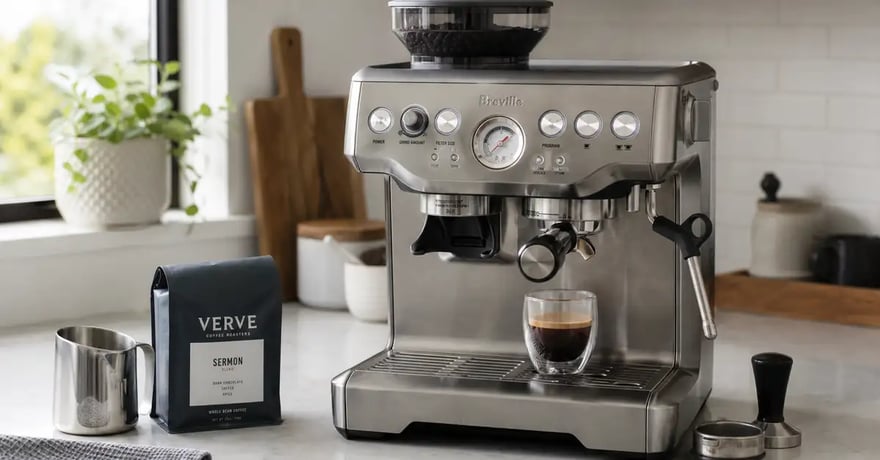
The best budget espresso machine is the Breville Bambino — at the upper edge of budget territory, it delivers more genuine espresso capability per dollar than anything else in the $$ band. In the $ band, the De'Longhi Stilosa is the best pump machine for the money; at entry-band pricing with a built-in grinder, the Casabrews Ultra is the most practical all-in-one option; and for convenience-first buyers with more to spend, the De'Longhi Magnifica S is the best-value bean-to-cup super-automatic.
Price tiers are relative to this guide: $ = budget · $$ = mid · $$$ = premium · $$$$ = high-end.
We evaluated 13 machines across four US price tiers — $, $$, $$$, and $$$$ — drawing on specialist coffee publications, manufacturer data, and comparative buying guides published between 2024 and 2026. No hands-on testing — our methodology is below.
Disclosure: Some links on this page are affiliate links. Café Grade may earn a commission if you purchase — at no extra cost to you. This doesn't affect our rankings. Full disclosure.
Best budget espresso machines compared (2026)
| # | Machine | Tier | Price band | Best for | Buy |
|---|---|---|---|---|---|
| 1 | De'Longhi Stilosa Best $ | $ | $ | Lowest pump machine entry | Amazon → |
| 2 | Breville Bambino ★ Best Overall | $$ | $$ | Best machine for the money | Amazon → |
| 3 | Casabrews Ultra (with grinder) | $ | $$ | All-in-one on a tight budget | Amazon → |
| 4 | Nespresso Essenza Mini | $ | $ | Zero-effort capsule entry | Amazon → |
| 5 | Nespresso CitiZ | $$ | $$ | Design-conscious capsule buyers | Amazon → |
| 6 | Breville Bambino Plus Best $$$ | $$$ | $$$ | Auto milk, compact | Amazon → |
| 7 | Gaggia Classic Up | $$$ | $$ | PID semi-auto upgrade path | Amazon → |
| 8 | Lelit Anna PL41TEM | $$$$ | $$$ | Prosumer quality on a budget | Amazon → |
| 9 | Lelit Victoria PL91T | $$$$ | $$$$ | E61 heat-exchanger value | Amazon → |
| 10 | De'Longhi Magnifica S Best Super-Auto | $$$$ | $$$ | Best-value bean-to-cup | Amazon → |
| 11 | De'Longhi Magnifica Evo | $$$$ | $$$ | Super-auto with better espresso | Amazon → |
| 12 | Philips 3300 LatteGo | $$$$ | $$$ | Push-button milk drinks | Amazon → |
| 13 | Nespresso Vertuo Plus | $ | $$ | Budget capsule — multiple sizes | Amazon → |
$: the best budget espresso machines
In the $ band, you have three distinct paths: a simple pump semi-automatic (the Stilosa), a capsule machine (Nespresso), or a budget all-in-one with a built-in grinder (Casabrews). Each makes a different trade-off between control, convenience, and long-term cost.
1. De'Longhi Stilosa (EC230BK)
Semi-automatic · 15-bar vibratory pump · Pressurised basket · Panarello steam wand · Compact
Best for: Buyers who want a real pump espresso machine — not a steam toy — at the lowest possible price.
Balance Journal's 2026 review of the Stilosa is honest: "It feels light when you lift it... the build communicates exactly what it is: a budget machine engineered to a price." But it is a pump machine — 15-bar vibratory pump, pressurised basket, and a Panarello wand. At $, it's the most accessible entry point to pump-driven espresso. The pressurised basket is forgiving with pre-ground supermarket coffee and will produce crema whether or not your technique is perfect, which makes it a useful test for whether home espresso fits your lifestyle before committing more. The Panarello wand produces usable foam for cappuccinos, though not the microfoam of a manual wand.
✓ Pros: pump-driven (not steam pressure); compact footprint; simple controls; forgiving pressurised basket; strong De'Longhi brand support.
✗ Cons: light plastic construction; Panarello wand produces airy foam, not microfoam; pressurised basket hides extraction quality; no non-pressurised basket option; limited upgrade path from this platform.
Recall status: No CPSC recall found. Confirmed active in De'Longhi US catalog and Balance Journal 2026 review.
2. Breville Bambino
Semi-automatic · Thermocoil · 54 mm portafilter · 3-second heat-up · Both pressurised and non-pressurised baskets
Best for: Anyone who can stretch to $$ — the most genuine espresso capability per dollar in this guide.
The Breville Bambino is where budget espresso ends and real espresso begins. Everyday People Coffee & Tea's 2025 evaluation describes it as "not a toy, not a pod machine dressed up as an espresso maker, and not a beginner machine you'll outgrow in six months." Multiple 2024–2026 buying guides cite it as the strongest value in the $$ tier. Its 3-second heat-up, 54 mm portafilter, and real manual steam wand give you something to grow into. It ships with both pressurised and non-pressurised baskets — start forgiving, graduate to skilled extraction when you're ready. The most significant limitation is the need for a separate grinder, but the machine itself will not hold you back.
✓ Pros: fast 3-second heat-up; real manual steam wand; both basket types included; compact footprint; clear skill development path; widely serviced.
✗ Cons: requires a separate grinder (adds $ to system cost); single thermocoil — alternate brew and steam; lighter build than prosumer alternatives.
Recall status: No CPSC recall found. Confirmed in active production via multiple 2024–2026 specialist reviews and current Breville US catalog.
3. Casabrews Ultra Espresso Machine (with built-in grinder)
Semi-automatic · Built-in grinder · 15-bar Italian pump · All-in-one design · Compact
Best for: Budget-constrained buyers who want a machine and grinder in one box — and don't want to source components separately.
Food & Wine's 2024 coverage presents the Casabrews Ultra as delivering Barista Express-level functionality for around $ instead of $$$ — its 15-bar Italian pump, built-in grinder, and integrated design make it one of the most practical budget all-in-one options. For buyers who would otherwise skip a grinder to stay on budget (using pre-ground coffee, which significantly limits espresso quality), having a built-in grinder — even a modest one — produces meaningfully better results. The trade-off: Casabrews is a newer brand without Breville's or De'Longhi's long-term service network, and the integrated grinder's precision has a lower ceiling than a standalone unit. A sensible choice if budget is the hard constraint and you want machine + grinder in one purchase.
✓ Pros: machine and grinder in one box at budget price; 15-bar Italian pump; compact all-in-one design; good value for the price point.
✗ Cons: newer brand with limited long-term service track record; integrated grinder precision below a standalone unit; if the grinder fails, the whole unit needs service; grinder and machine can't be upgraded independently.
Recall status: No CPSC recall found in Food & Wine 2024 coverage. As a newer brand, verify warranty and retailer return policy before purchase.
4. Nespresso Essenza Mini (Original Line)
Capsule · Original-line pods · Compact · Espresso and lungo · No milk system
Best for: Small kitchens or offices that want the simplest possible path to consistent espresso-style drinks, with no grinder, no technique, and minimal counter space.
DripRoast's 2026 Nespresso guide identifies the Essenza Mini as the "best budget" Nespresso model, typically priced at $ in the US. As an Original-line machine, it benefits from a competitive pod ecosystem — Starbucks, Peet's, Lavazza, and various store brands make compatible pods, keeping ongoing costs more manageable than Vertuo. DripRoast estimates Original pods at $ per pod (Nespresso branded) or $ for third-party. For two coffees a day, that's $$$ annually — a cost worth understanding upfront. The machine itself is extremely compact, reliable, and approachable for anyone wanting café drinks without any preparation ritual.
✓ Pros: smallest footprint in this guide; Original-line allows third-party pods; no technique required; highly consistent results; widely available and serviced by Nespresso.
✗ Cons: ongoing pod costs can outpace a semi-automatic + grinder over 3–5 years; no milk system included; limited flavor control; doesn't produce traditional pump espresso.
Recall status: No CPSC recall found. Active in Nespresso US catalog; DripRoast 2026 confirms current product status.
5 (Capsule alternative). Nespresso Vertuo Plus
Capsule · Centrifusion extraction · Multiple cup sizes · Vertuo-only pods
Best for: Buyers who want a wider range of cup sizes — from espresso to full mug — and prefer the Vertuo ecosystem over Original-line.
The Vertuo Plus offers something the Essenza Mini doesn't: multiple cup sizes including full 8 oz and 14 oz mugs via Centrifusion barcode-based extraction. For households that want both espresso shots and regular-size coffees from one machine, this versatility is the main appeal. The trade-off vs the Essenza Mini: Vertuo pods are proprietary to Nespresso (no third-party alternatives), costing $ each — materially more expensive per cup than Original-line pods. Over 5 years of daily use, the pod cost difference adds up significantly. Choose Essenza Mini (Original) if you mostly drink espresso and want lower ongoing pod costs; choose Vertuo Plus if cup-size range matters more.
✓ Pros: multiple cup sizes from espresso to mug; consistent barcode-based extraction; easy to use and clean; versatile for mixed-size households.
✗ Cons: Vertuo pod lock-in — no third-party pods; higher per-cup cost than Original-line; ongoing costs significantly higher than semi-auto + grinder over 5 years.
Recall status: No CPSC recall found. Active in Nespresso US catalog.
$$: the best mid-budget espresso machines
In this tier, the Breville Bambino is the clear semi-automatic leader. The Nespresso CitiZ offers a design-focused capsule option. For all-in-one buyers already stretching toward $$, the Barista Express starts to become viable at the upper end of this range.
6. Nespresso CitiZ (Original Line)
Capsule · Original-line pods · Slim profile · Design-focused · Optional milk bundle
Best for: Design-conscious buyers who want a premium-looking capsule machine at a modest price — with access to the wide Original-line pod ecosystem.
DripRoast's 2026 guide categorizes the CitiZ as the "Best Design" choice in the Nespresso Original line — slim, stylish, and built with a more premium feel than the Essenza Mini at a slightly higher price. It uses the same Original-line pods (including third-party alternatives from Starbucks, Peet's, and others), meaning ongoing pod costs are more manageable than Vertuo. Available bundled with an Aeroccino milk frother in some configurations, which brings latte capability without a steam wand. The extra spend over the Essenza Mini buys aesthetics and build quality rather than better espresso performance — the extraction system is fundamentally the same.
✓ Pros: slim, design-forward profile; Original-line pod ecosystem (third-party pods available); available with Aeroccino milk frother bundle; reliable Nespresso support.
✗ Cons: same espresso quality as the cheaper Essenza Mini; ongoing pod costs; no manual extraction control; Aeroccino frother bundle adds cost vs buying separately.
Recall status: No CPSC recall found. Active in Nespresso US catalog; DripRoast 2026 confirms current product.
$$$: the best espresso machines in the mid-range
At $$$, two strong semi-automatics emerge: the Breville Bambino Plus (the automatic-milk version of the Bambino) and the Gaggia Classic Up (the best-value PID semi-automatic for skill-focused buyers). Both are significantly more capable than anything in the tiers below. If a specific price ceiling is your actual constraint rather than a general budget tier, our best espresso machines under $500 guide is built specifically around that number — six manufacturer-verified picks, with anything priced above it named and excluded rather than quietly included.
7. Breville Bambino Plus
Semi-automatic · Automatic milk texturing · Thermocoil · 54 mm portafilter · Pre-infusion
Best for: Buyers who want the Bambino platform with automatic milk texturing — lattes and flat whites without mastering manual steam technique.
The Bambino Plus adds automatic milk texturing to the standard Bambino — it steams milk to a user-selected temperature and foam level automatically, removing the need to learn manual wand technique. Espresso Rabbit Hole's review rates it among the best compact semi-automatics for this reason. Pre-infusion (gentle water contact before full extraction pressure) is included, which reduces channelling and is particularly helpful with freshly roasted beans. The fundamental trade-off vs the standard Bambino: the automatic milk system is convenient but may discourage learning manual steam technique, which would otherwise transfer to any machine you upgrade to. A strong choice if milk drinks are the priority and technique development is not.
✓ Pros: automatic milk texturing with adjustable temperature and foam level; pre-infusion; fast heat-up; compact; same 54 mm portafilter as higher-end Breville machines.
✗ Cons: automatic milk system may discourage learning manual steam technique; brew temperature not user-adjustable; requires a separate grinder; lighter build than prosumer alternatives.
Recall status: No CPSC recall found. Active production confirmed by 2024–2026 specialist reviews and Breville US catalog.
8. Gaggia Classic Up
Semi-automatic · PID temperature control · Manometer · Brass boiler · 58 mm portafilter · 3-way solenoid
Best for: Skill-focused buyers who want a PID semi-automatic at a budget price — with a 58 mm group they won't outgrow.
The Gaggia Classic Up brings PID temperature control and a manometer to the Classic line — Whole Latte Love's 2026 review confirms the improvements. At $$, this is one of the few machines in this price range with PID, a brass boiler for thermal stability, and a 58 mm commercial-size group head. The 3-way solenoid allows dry-puck ejection and effective backflushing. For buyers who want to develop real espresso technique on a budget, this is the best machine in the $$$ range. It's less forgiving than the Bambino Plus — it rewards correct technique and won't hide poor preparation — but it teaches you more and has a longer useful life.
✓ Pros: PID temperature control; manometer; 58 mm commercial-size group; brass boiler; 3-way solenoid; wide aftermarket accessory ecosystem; built to last.
✗ Cons: single boiler — alternate brew and steam; requires a capable grinder; steeper learning curve than Bambino-style machines; less forgiving of poor technique.
Recall status: No CPSC recall found. Gaggia official page and Whole Latte Love 2026 review confirm active production.
$$$$: best value espresso machines
At $$$$, the definition of "budget" shifts — you're now in entry prosumer and mid-range super-automatic territory. Two Italian semi-automatics (Lelit) and three super-automatics (De'Longhi, Philips) stand out as the best value in this tier.
9. Lelit Anna PL41TEM
Semi-automatic · PID temperature control · 57.35 mm portafilter · Single boiler · Made in Italy · Thermometer
Best for: Enthusiasts who want 80–90% of prosumer performance at roughly half the price of a $$$$ machine.
Everyday People Coffee & Tea's 2025 round-up explicitly identifies the Lelit Anna as delivering "80–90 per cent of the performance of 2,000-dollar machines at around half the price." The Anna combines PID temperature control, a thermometer for precise monitoring, and quality Italian construction at a price that undercuts most comparable E61 machines. Its 57.35 mm portafilter (close to the 58 mm commercial standard) accepts a wide range of baskets and accessories. For buyers who are serious about espresso and want a machine that will grow with them, the Anna is one of the most compelling values in this price range.
✓ Pros: PID temperature control; thermometer; quality Italian construction; strong espresso performance for the price; wide accessory compatibility; upgradeable workflow.
✗ Cons: single boiler — alternate brew and steam; not as intuitive as Bambino-style machines; requires a capable grinder; less of a known brand in the US vs Breville or De'Longhi.
Recall status: No CPSC recall found. Active in Lelit's product line; referenced in 2025 comparative reviews as a current product.
10. Lelit Victoria PL91T
Semi-automatic · E61 group · PID · Single boiler · Rotary pump option · Made in Italy
Best for: Serious espresso enthusiasts who want a long-term prosumer platform without spending $$$$ on a dual-boiler machine.
The Lelit Victoria is a step up from the Anna — E61 group, rotary pump option, and more refined temperature management at $$$$. Everyday People Coffee & Tea's 2025 guide positions both Lelit machines as delivering prosumer-class results at budget-relative prices compared to comparable E61 machines from ECM or Rocket. The E61 group provides excellent thermal stability once warmed up and is compatible with the full range of commercial-grade portafilters and accessories. For buyers making a single purchase intended to last 10+ years, the Victoria is a compelling proposition. Warm-up time (15–30 min for the E61 group) is the main workflow adjustment.
✓ Pros: E61 group — excellent thermal stability; PID temperature control; quality Italian construction; wide accessory ecosystem; built for longevity; rotary pump option reduces vibration.
✗ Cons: 15–30 minute warm-up for E61 group; single boiler limits steaming throughput; requires a capable grinder; less familiar brand in US market than Breville or Jura.
Recall status: No CPSC recall found. Active in Lelit's product catalog; referenced in 2025 reviews as a current product.
11. De'Longhi Magnifica S
Super-automatic · Bean-to-cup · Integrated burr grinder · One-touch espresso and lungo
Best for: Convenience-first households who want consistent bean-to-cup espresso at the lowest point of the super-automatic range.
Espresso Rabbit Hole's 2024 super-automatic ranking names the De'Longhi Magnifica S as the best budget option for those who want quality black coffee, noting its "strong value and adequate milk performance." The same article concludes that "without question, the best value in the super-automatic world comes from De'Longhi," with the Magnifica line representing the accessible end of that value story. The Magnifica S provides one-touch espresso and lungo with an integrated grinder at a price that's more accessible than the Evo or Evo Next. Milk steaming is manual (Panarello-style), which is less convenient than the auto-milk systems on higher-end machines but keeps the price lower.
✓ Pros: lowest-price-point De'Longhi bean-to-cup; one-touch espresso and lungo; integrated grinder; reliable extraction; strong brand support.
✗ Cons: Panarello milk steaming is manual rather than automatic; limited customisation vs higher-end Magnifica Evo; super-auto flavor ceiling vs skilled semi-auto.
Recall status: No CPSC recall found. Active in De'Longhi US catalog; Espresso Rabbit Hole 2024 confirms current product.
12. De'Longhi Magnifica Evo
Super-automatic · Bean-to-cup · Built-in burr grinder · One-touch drinks · Improved espresso vs Magnifica S
Best for: Buyers who want noticeably better espresso quality from a super-automatic and can spend $ more than the Magnifica S.
Tom's Coffee Corner's review rates the Magnifica Evo's espresso as "pretty well balanced, with above average body for a superautomatic" — a meaningful step up from the Magnifica S. The Evo adds improved brewing parameters and a more refined grinder over the S, producing espresso that holds up better for drinking straight rather than just as a base for milk drinks. CoffeeBlog's 2026 commentary confirms De'Longhi's Magnifica line as offering "strong value without sacrificing core coffee quality." If you're spending time in the $$$ range on a super-automatic, the Evo is the better value over the S for espresso quality; spend more for the Evo Next if you want the auto-milk carafe.
✓ Pros: better espresso quality than Magnifica S; one-touch drinks; integrated grinder; one-touch programs; consistent daily performance.
✗ Cons: super-auto flavor ceiling vs skilled semi-auto; limited extraction customisation; higher price than Magnifica S; no auto-milk carafe at base configuration.
Recall status: No CPSC recall found. Active in De'Longhi US catalog and multiple 2024–2026 reviews.
13. Philips 3300 LatteGo
Super-automatic · LatteGo milk system · Bean-to-cup · 12-step grind adjustment · Easy-clean milk carafe
Best for: Households that drink mostly lattes and cappuccinos and want push-button milk drinks with minimal cleaning effort.
The Philips 3300's LatteGo milk system is its defining feature — a lidless, tubeless carafe that disassembles into just two parts for rinsing, producing milk foam at the press of a button. Seattle Coffee Gear's comparison of the 3300 vs 5500 confirms the 3300 delivers similar daily-driver results for most users. Espresso Rabbit Hole's 2024 guide notes the 3300 as an alternative to the Magnifica S, specifically for buyers who prioritize milk drink convenience. The milk system is genuinely easier to maintain than traditional integrated milk systems, which matters if you make multiple milk drinks daily. Espresso quality is comparable to other machines in this tier — the LatteGo advantage is in the milk workflow.
✓ Pros: LatteGo milk system is the easiest to clean in this category; one-touch cappuccino and latte; consistent results; relatively quiet operation.
✗ Cons: milk foam quality below a trained manual steam wand; limited espresso customisation; super-auto flavor ceiling; higher price than Magnifica S for similar espresso quality.
Recall status: No CPSC recall found. Active in Philips US catalog and multiple 2024–2026 specialist reviews.
How we selected these machines
This guide is research-led, not based on hands-on testing. We evaluated 13 machines across four price tiers, drawing on specialist coffee publications, mainstream consumer media, manufacturer specifications, and comparative buying guides published between 2024 and 2026. No physical product testing was conducted or claimed.
Selection criteria
- Value for money: What do you get per dollar, relative to other machines in the same price tier?
- Upgrade path: Does the machine let you develop skills over time, or is it a ceiling?
- Milk drink capability: Can the machine produce lattes and cappuccinos, and at what effort level?
- Long-term cost: For capsule machines, we flag total-cost-of-ownership trade-offs vs semi-automatics.
- Recall and availability: All machines are screened for active CPSC safety notices. Buyers are encouraged to verify directly at cpsc.gov before purchase.
- Source triangulation: Every machine is cross-referenced across at least two independent sources.
Frequently asked questions
What is the best espresso machine in the $ band?
For a pump semi-automatic, the De'Longhi Stilosa is the strongest choice in the $ band — a genuine pump machine with a pressurised basket and Panarello wand. For zero technique with the most minimal footprint, the Nespresso Essenza Mini (Original line) is the cleanest capsule entry point. The Casabrews Ultra offers a built-in grinder all-in-one at the upper edge of this range.
Is a Nespresso machine cheaper to run than a semi-automatic?
The machine is cheaper upfront, but ongoing pod costs significantly outpace a semi-automatic + grinder over time. DripRoast estimates Original-line pod costs at $$$ annually for two coffees per day, depending on brand. Over 5 years, that's $$$$ in pods alone — materially more than the total system cost of a Bambino and a burr grinder. Capsule machines are worth the trade-off if convenience is the priority; semi-automatics are better long-term value if you're cost-conscious.
What is the best budget espresso machine for milk drinks?
The Breville Bambino Plus (automatic milk texturing, $$$) is the best budget option for easy milk drinks. If you want push-button lattes from a bean-to-cup machine, the Philips 3300 LatteGo has the easiest-to-clean milk system in this guide. At entry-band pricing with milk capability, pair the Nespresso Essenza Mini with an Aeroccino frother.
Do I need to buy a grinder separately for a budget espresso machine?
Yes, for most semi-automatics. Freshly ground coffee makes a significant difference to espresso quality. The Breville Barista Express (with built-in grinder) and Casabrews Ultra eliminate this need. For machines without a built-in grinder like the Bambino, a burr grinder in the $ range is the most impactful addition. Capsule machines (Nespresso) require no grinder at all.
What does a pressurised filter basket do?
A pressurised basket has a secondary wall with a small hole that creates artificial back-pressure during extraction, making espresso forgiving of coarse grinds and inconsistent tamping. Budget machines like the Stilosa and Casabrews rely on these for consistent results at entry-level. The Bambino ships with both pressurised and non-pressurised baskets — start forgiving, progress to skilled extraction over time.
When does it make sense to spend $$$$ on a "budget" machine?
If you're buying a machine you intend to use for 5–10 years, machines like the Lelit Anna or Lelit Victoria offer prosumer-level construction and performance at a fraction of the cost of a full prosumer machine. For super-automatics, the De'Longhi Magnifica S or Evo deliver consistent bean-to-cup convenience at a price that's genuinely budget relative to Jura or higher-end Philips. The $$$$ tier makes most sense when you've confirmed that espresso at home is a long-term habit.
More espresso guides
Everything you need before you buy
Best Espresso Machines of 2026All price points and types compared
Best Espresso Machines for Beginners10 picks focused on first-time buyers
Best Espresso GrindersFind the right grinder for your machine
How to Dial In EspressoGrind, dose, yield — step by step