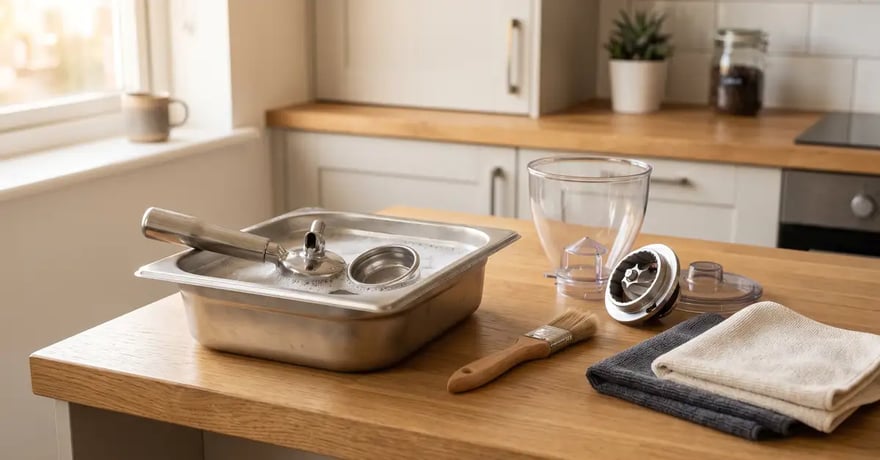
Descale on water hardness and how often you brew — not on a fixed calendar date. Hard water scales up an espresso machine or drip maker in weeks; soft or filtered water can stretch that to six months. As a rule of thumb: espresso machines and drip makers every 1–3 months on hard water (every 3–6 months on soft/filtered water or a built-in filter), burr grinders get a dry brush-out every 1–2 weeks (never water on the burrs), and manual brewers (French press, AeroPress, V60) get a rinse after every use and a soap wash weekly.
Disclosure: Some links on this page are affiliate links. Café Grade may earn a commission if you purchase — at no extra cost to you. This doesn't affect our recommendations. Full disclosure.
Cleaning and descaling schedule at a glance
| Gear | Daily | Weekly | Monthly | Quarterly (or per hardness) |
|---|---|---|---|---|
| Espresso machine | Purge steam wand, wipe drip tray | Backflush (if applicable), wipe group gasket | Degrease portafilter & baskets | Descale (1–3 months hard water, 3–6 months soft/filtered) |
| Drip coffee maker / pod machine | Empty & rinse carafe/basket | Wash carafe and basket in soapy water | Clean reservoir, check for biofilm | Descale per manufacturer indicator light or every 2–3 months |
| Burr grinder | — | Dry-brush hopper throat & chute | Remove upper burr, brush chamber; wash hopper/bin (soapy water, never the burrs) | Full teardown brush-out every 3 months of daily use |
| French press / moka pot / AeroPress / V60 | Rinse after every use | Wash with mild soap (moka pot: water only, no soap) | Descale kettle-style parts if hard water | Replace AeroPress seal / moka gasket as needed |
| Milk frother / steam wand | Purge and wipe immediately after use | Soak detachable parts, clear steam tip holes | Full disassembly where the design allows | — |
Espresso machines: backflushing, descaling and the parts people skip
Two separate jobs get confused constantly: backflushing clears coffee oils out of the brew group; descaling clears mineral scale out of the boiler and water lines. You need both, on different schedules, and neither substitutes for the other.
Backflushing only applies to machines with a three-way solenoid valve (most prosumer semi-automatics; check your manual — many entry-level pump machines, including simple thermoblock models, can't be backflushed and shouldn't have the process forced on them). The routine: fit the blind (solid) filter basket into the portafilter, drop in a cleaning tablet or a pinch of espresso machine cleaner, and run the brew cycle in short bursts so the solvent recirculates through the group head rather than draining into the cup. Rinse with several plain-water cycles afterward. Manufacturer guidance for machines like Breville's Barista Express line calls this the "CLEAN" cycle and is explicit that it should be run on a fixed interval, not only when the shot tastes off.
Descaling is a different chemical job aimed at the boiler, thermoblock and internal tubing. Manufacturer guides for both Breville and De'Longhi are specific here: use the machine's own descaling powder or solution (or a citric-acid-based descaler where no proprietary product exists), run the machine's dedicated descale mode if it has one, and always finish with at least one full rinse cycle of plain water before making coffee again. Skipping the final rinse is one of the most common reasons a descaled machine tastes wrong for the next few shots.
Don't forget the parts a descale cycle never touches: the group head gasket and shower screen (soak or brush separately — they trap old grounds and oil), the portafilter and baskets (a dedicated degreaser or an overnight hot-water-and-detergent soak clears the crema-killing buildup a rinse never will), and the drip tray and water tank, which grow biofilm just as readily as any other reservoir.
Drip coffee makers and pod machines: the reservoir nobody thinks about
Drip machines and pod machines scale exactly the same way espresso machines do — hard water leaves mineral deposits in the internal tubing and heating element, which shows up first as a slower brew cycle and then as a burnt or muted taste. Run the machine's built-in descale cycle (usually a plain-water-and-descaler run through an empty brew cycle) on the interval your manual specifies, or every 2–3 months as a default if there's no indicator light.
The part that gets neglected: the water reservoir itself. It's dark, damp, and rarely fully dries between uses — exactly the conditions biofilm needs. Wash it with warm soapy water on the same cadence as the carafe and basket, not only when you remember to descale.
Burr grinders: dry-brush only, never water on the burrs
Grinder cleaning is where the manufacturer guidance is most consistent and most different from instinct. Every burr grinder manufacturer we checked — Baratza's own cleaning guide included — gives the same instruction: the steel burrs get brushed dry, never washed. Water on steel burrs causes rust and pitting, which ruins grind consistency permanently. The routine: remove the hopper and (on most home grinders) the upper burr, brush out loose grounds and residue from the chamber and chute with the supplied brush, and stop there for the burrs themselves.
Everything that isn't the burr assembly — the hopper, hopper lid, and grounds bin — is dishwasher-unfriendly plastic that's perfectly fine in warm soapy water; rinse and dry completely before reassembling, since trapped moisture near the burr chamber defeats the point of keeping the burrs dry. Do a full brush-out every couple of weeks with daily use, and a deeper teardown (removing the burr and cleaning the chamber and chute thoroughly) every few months. Grinder-cleaning tablets (rice-based polymer pellets ground through like coffee) help clear oil buildup from the burr chamber between full teardowns, but they don't replace the brush.
Stale grounds trapped in the chute and retention chamber are also a flavor problem on their own — see our guide to storing coffee beans for why fresh-ground matters as much as the cleaning schedule.
French press, pour-over, moka pot, AeroPress and cold brew
French press: disassemble the plunger and mesh screen after every use and rinse immediately — trapped coffee oil on the mesh is what makes reused presses taste stale. Warm soapy water for the glass and metal parts weekly; go easier with detergent on plastic lids and frames, since strong soap can be absorbed and linger as an off-flavor.
Moka pot: the enduring stovetop-coffee convention is water only, no soap, on the inside. The logic: moka pots build up a thin coffee-oil patina inside the aluminum or steel chamber over repeated brews, and many long-time owners and manufacturer care notes treat that patina the way a seasoned cast-iron pan is treated — soap strips it and can affect flavor on the next few brews. Rinse thoroughly with hot water, air-dry fully (trapped moisture corrodes aluminum pots), and replace the rubber gasket when it hardens or cracks.
AeroPress: official manufacturer guidance is refreshingly low-maintenance — a rinse under lukewarm water after each use is sufficient for daily cleaning, since the plunger physically wipes the chamber as it pushes the puck out. Periodically (weekly for regular use), remove the rubber seal from the plunger and wash it and the chamber with mild soap and water; the filter cap is dishwasher-safe on the top rack.
Pour-over (Hario V60 and similar): manufacturer instructions specify a warm-water rinse after every brew, with an occasional deeper clean using mild dish soap and a soft sponge — ceramic and many plastic V60 drippers are top-rack dishwasher-safe for that deeper clean. Avoid abrasive scrubbing on the ridged interior, which is there to control flow, not to be polished smooth.
Cold brew: whatever vessel or filter system you use, the same rule applies as pour-over — rinse the filter and vessel immediately after straining, since spent grounds left to sit are the fastest route to a sour, stale-tasting batch next time.
Milk frothers and steam wands
Milk protein bakes onto a steam wand or an automatic frother's internals faster than almost anything else in a coffee setup, and it happens within minutes of use, not days. The one habit that prevents nearly all of it: purge the wand with a short burst of steam into a cloth immediately after frothing, then wipe the outside while it's still warm. For automatic milk systems (built into some super-automatics), run the machine's dedicated milk-system clean cycle after every session and disassemble the parts that come apart for a proper wash on the schedule the manual specifies — milk residue trapped inside a sealed frothing wand is a bacterial-growth problem, not just a taste one.
Descaling agents: citric acid, commercial descaler, or vinegar?
This is the question we get asked most, and manufacturer guidance across the brands we checked is more consistent than the internet's vinegar-descaling folklore suggests: use the machine's own descaling powder or solution, or a citric-acid-based descaler, and skip vinegar unless your specific manual says otherwise.
Both Breville's and De'Longhi's own cleaning documentation point owners to their proprietary descaling products rather than vinegar, and independent technical write-ups explain why: vinegar's acetic acid is more aggressive toward aluminum components and rubber or silicone seals than a citric-acid-based descaler is, which on some machines raises a real corrosion and gasket-degradation risk over repeated use — and using an unapproved cleaning agent can complicate a warranty claim if something does fail. Citric acid dissolves limescale just as effectively without that corrosion profile, and it doesn't leave the lingering taste vinegar can require several rinse cycles to fully clear.
The practical takeaway: check your specific manual first. Some machines' manufacturers explicitly permit a diluted vinegar solution as a fallback when no proprietary descaler is available; others explicitly warn against it. When the manual doesn't say, a citric-acid-based descaler is the safer default for both metal components and seals, and it's what most brands sell as their own-name product for exactly that reason.
Water hardness: the upstream fix
Everything above gets easier — and the schedule above gets longer — if the water going into the machine is softer to begin with. A built-in or inline water filter (many machines ship with one, or accept an aftermarket cartridge) measurably slows scale buildup, which is why manufacturer descale-interval guidance is usually stated as a range rather than a fixed number: hard, unfiltered municipal or well water scales a machine in weeks; filtered or naturally soft water can stretch the same machine's descale interval to three to six months. If you're descaling every few weeks no matter what you do, checking your local water hardness and adding filtration is a more effective fix than descaling more often.
What neglecting this actually does
Scale buildup doesn't just risk an eventual failure — it shows up long before that as a slower brew or pump cycle, unstable brew temperature (which flattens espresso and makes drip coffee taste duller), and reduced steam power. Oil buildup in a portafilter basket or grinder chamber goes rancid and turns fresh beans bitter regardless of how good the beans are. Left long enough, scale can damage a heating element or boiler outright, turning a cleaning problem into a repair or replacement one. If a machine from any of our buying guides is underperforming despite fresh beans and a good grind, maintenance — not the machine — is usually the first thing to check.
Frequently asked questions
How often should I descale my espresso machine? Every 1–3 months with hard, unfiltered water; every 3–6 months with soft or filtered water, or whenever the machine's built-in indicator prompts it. Usage frequency matters as much as water hardness — a machine run twice a day scales faster than one used on weekends only.
Can I use vinegar to descale my espresso machine? Check your manual first. Several major manufacturers' own documentation recommends their proprietary descaler or a citric-acid-based product instead of vinegar, citing corrosion risk to aluminum parts and seals over repeated use. A citric-acid descaler is the safer default when your manual doesn't explicitly sanction vinegar.
Can I wash my burr grinder with water? Not the burrs themselves — manufacturer guidance is consistent that steel burrs should be brushed dry, never washed, to avoid rust and pitting. The hopper, hopper lid and grounds bin can be washed in warm soapy water and dried thoroughly before reassembly.
Why shouldn't I use soap on a moka pot? The long-standing convention among moka pot owners and much manufacturer care guidance is that soap strips the thin coffee-oil patina that builds up inside the chamber over time, which can affect flavor on the next several brews. Rinse with hot water only and dry completely to prevent aluminum corrosion.
What happens if I never descale my machine? Performance degrades gradually first — slower brew cycles, unstable temperature, weaker steam — before any outright failure. Left long enough, scale buildup can damage a heating element or boiler, turning routine maintenance into a repair bill.
Do I need different cleaning products for different machines? For descaling, yes — use your machine's proprietary descaler where one exists, since it's formulated for that machine's internal materials. For everyday cleaning (grinder brushes, portafilter degreaser, cleaning tablets for backflushing), a general espresso-machine cleaning tablet or citric-acid descaler works across most brands; check the box for any material exclusions.
Reach for a citric-acid descaling solution, a set of backflush cleaning tablets, or a dedicated grinder brush to cover the routine above — paid links, prices change frequently, commissions don't affect our recommendations.
For machine-specific buying advice, see our guides to the best espresso machines, best coffee makers, best burr grinders, best coffee grinders, best French presses, best moka pots, best AeroPress alternatives and best milk frothers — and our coffee-to-water ratio guide for the other half of consistent results.